One day last week I decided to go out and see if I could find one of the UK’s rarer butterflies…the WOOD WHITE (Leptidea sinapis)..a UK priority species, as this extract taken from the UK Butterflies website explains.
Despite relatively short-term increases, the long-term view is that this butterfly is in decline and is therefore a priority species for conservation efforts. This butterfly has suffered due to a change in woodland management and, in particular, the reduction in coppicing that allows new woodland clearings to develop that provides the conditions suitable for this species. Even improvements in habitat management will not guarantee that the species will reappear from areas where it has been lost, since it is not a very mobile species and may not, therefore, be able to recolonise naturally.
I knew that some had been seen in a wood in the south of Northamptonshire, about an hours drive from home.
A weak sun in a hazy blue sky was doing it’s best to live up to the weather forecasters promise of a sunny and warm day as I set of from home at just after 7am. I was a little worried that my journey was going to be in vain as when I arrived the sun had been replaced by grey clouds and a decidedly chilly breeze, not good conditions for butterfly hunting!
As I’d made the effort I decided to have a wonder anyway and see what I could find and, to my amazement, less than 200yards from the car park I saw my first butterfly…and it was a Wood White!
 After taking a few photographs, and feeling rather chuffed at finding my target species in such a short time, I decided to carry on along the track, it looked like good bug hunting territory!, to see what I could find. After about a mile and 2 hours of slow progress (lots of bug photos!) I saw two more of my target butterflies.
 Nearly 4 hours had elapsed by the time I arrived back at the car and by now the clouds had disappeared and it was a sunny and warm 20°. After a drink and a quick bite to eat I went ‘exploring’ along another track that led off in the opposite direction and within minutes I’d hit a Wood White hotspot, I walked along the track for about 3/4 of a mile and stopped counting them when I got to 30, they seemed to be everywhere, slowly flitting along the track edge and occasionally having a little aerobatic tussle with a rival, or two!
I was also lucky to see a pair start to engage in a courtship display, unfortunately they where ‘bombed’ by another rival and all three flew off in different directions.
Again taken from the UK Butterflies website…The courtship of this butterfly is an amazing spectacle. Male and female face each other with wings closed and intermittently flash open their wings. At the same time, the male waves his proboscis and white-tipped antennae either side of the female's head. If the female is receptive to these signals, the female bends her abdomen toward the male and the pair mate, staying coupled for around 30 minutes.
Nearly 4 hours had elapsed by the time I arrived back at the car and by now the clouds had disappeared and it was a sunny and warm 20°. After a drink and a quick bite to eat I went ‘exploring’ along another track that led off in the opposite direction and within minutes I’d hit a Wood White hotspot, I walked along the track for about 3/4 of a mile and stopped counting them when I got to 30, they seemed to be everywhere, slowly flitting along the track edge and occasionally having a little aerobatic tussle with a rival, or two!
I was also lucky to see a pair start to engage in a courtship display, unfortunately they where ‘bombed’ by another rival and all three flew off in different directions.
Again taken from the UK Butterflies website…The courtship of this butterfly is an amazing spectacle. Male and female face each other with wings closed and intermittently flash open their wings. At the same time, the male waves his proboscis and white-tipped antennae either side of the female's head. If the female is receptive to these signals, the female bends her abdomen toward the male and the pair mate, staying coupled for around 30 minutes.
 Despite missing out on the full courtship display it turned out to be a very successful day, the ironic thing is that about thirteen years ago I actually lived about ten minutes walk from this site and during my regular walks and mountain bike rides around the area I never knowingly saw one of these butterflies!
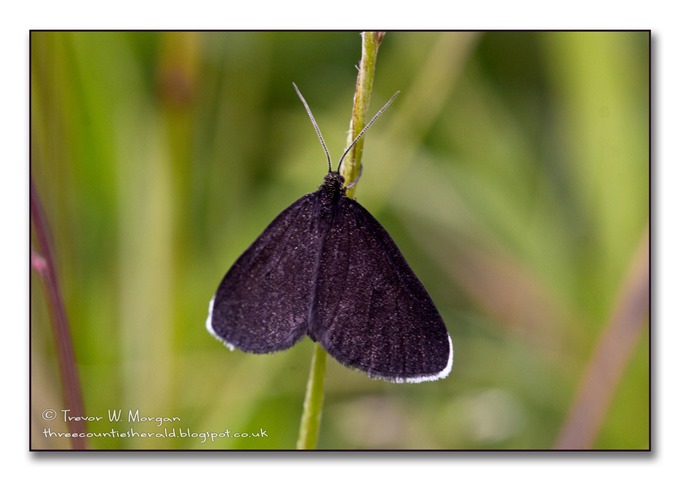
A couple of days later I went in search of my second target species, this time a day flying moth called the CHIMNEY SWEEPER (Odezia atrata). It was dull, overcast and windy for most of the day but at around 2.30pm the clouds parted and the sun began to shine and I made a spur of the moment decision to go out and see if I could find any. It was a thirty minute drive to the site where I’d seen them last year and when I arrived it was sunny and 19°. Again my luck was in as I soon spotted a couple perched low down in the grass, unfortunately it was still quite windy and they were staying well down and only occasionally making short, low flights. After a few failed attempts I managed to get a few decent images…
Despite missing out on the full courtship display it turned out to be a very successful day, the ironic thing is that about thirteen years ago I actually lived about ten minutes walk from this site and during my regular walks and mountain bike rides around the area I never knowingly saw one of these butterflies!
A couple of days later I went in search of my second target species, this time a day flying moth called the CHIMNEY SWEEPER (Odezia atrata). It was dull, overcast and windy for most of the day but at around 2.30pm the clouds parted and the sun began to shine and I made a spur of the moment decision to go out and see if I could find any. It was a thirty minute drive to the site where I’d seen them last year and when I arrived it was sunny and 19°. Again my luck was in as I soon spotted a couple perched low down in the grass, unfortunately it was still quite windy and they were staying well down and only occasionally making short, low flights. After a few failed attempts I managed to get a few decent images…
 It turned out to be not a bad week in the end!
It’s been a while since I inflicted the last lot of ‘bugs’ onto you, so I’m hoping that you’re sufficiently recovered by now and are ready for another dose?
The more that I get into insects the more fascinating I’m finding them…the vast array of bodily variations and adaptations, the patterning and colourings…a beautiful miniature world that the majority of people pass by without even noticing…….until they’re unfortunate enough to get stung or bitten, that is!…thankfully there’s not too many insects that have a viscous streak…there’s got to be a downside to everything I suppose?
Anyway, here’s some bugs, I promise that you won’t get stung or bitten!…
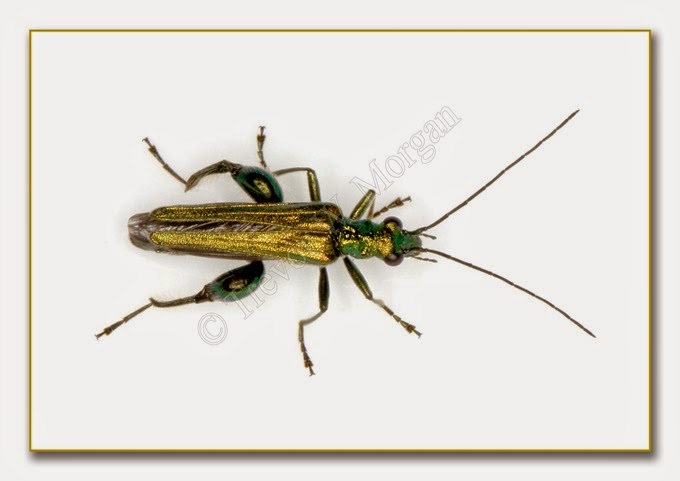
 Thick Legged Flower Beetle (Oedemera nobilis) Up to 10mm long. Two things distinguish this green/gold coloured beetle from other similar looking beetles, the ‘swollen’ hind legs (only the male has these) and the ‘ill fitting’ narrow elytra (the hardened wing cases). It’s a common beetle, but restricted to the southern half of the UK, and can be found feeding on the pollen of many wild flowers from April to August.
 Green-legged Sawfly (Tenthredo mesomelas) Up to 15mm long. This is one of a few very similar looking Sawflies and is very abundant throughout the UK from May to July. Sawflies are so named because most females have a saw-like ovipositor which they use to ‘inject’ their eggs into the plant tissue.
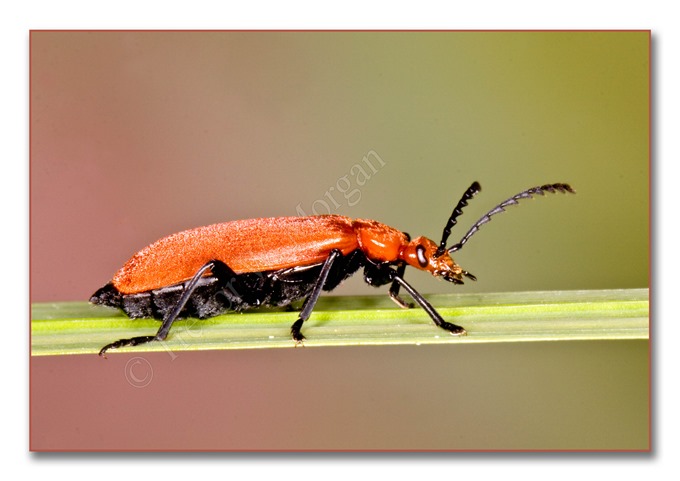 Red-Headed Cardinal Beetle (Pyrochroa serraticornis) Up to 18mm long. As it’s name suggests this beetles red head is it’s distinguishing feature, the very similar Cardinal Beetle (P. coccinea) has a black head. Both are found in the same sort of habitat, on the flowers and trees, along hedgerows and woodland margins from May to July. They are confined to England and Southern Ireland.
 Malachite Beetle (Malachius bipustulatus) Up to 8mm long. The large red spot on the rear end of this beetle set it apart from other similar beetles. Found over most of the UK from April to July in the grassy areas within woodlands where the adults feed on grass pollen while the larvae feed on the insects found under loose bark.
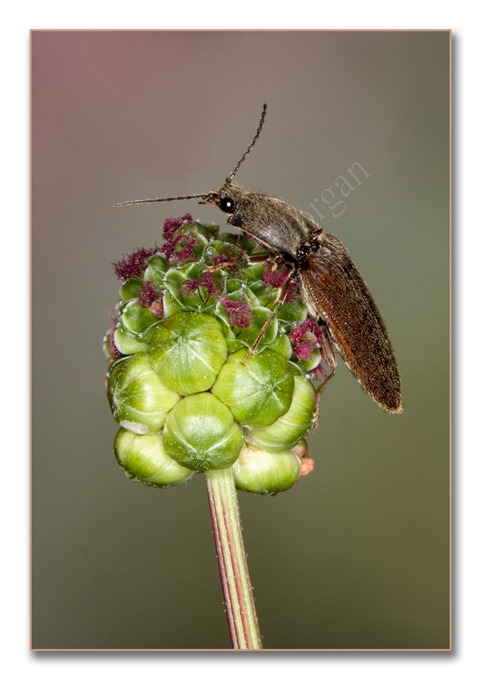 Click Beetle (Athous haemorrhoidalis) Up to 15mm long. This is the commonest of the UK’s click beetles and is distinguished by the elytra being covered in dense brown hairs. It is found in most wild and cultivated habitats throughout the UK from May to July. The larvae are classed as serious agricultural pests.
Click beetles get their name from having the ability to right themselves by springing into the air, this action is accompanied by a loud click.
Click Beetle (Athous haemorrhoidalis) Up to 15mm long. This is the commonest of the UK’s click beetles and is distinguished by the elytra being covered in dense brown hairs. It is found in most wild and cultivated habitats throughout the UK from May to July. The larvae are classed as serious agricultural pests.
Click beetles get their name from having the ability to right themselves by springing into the air, this action is accompanied by a loud click.
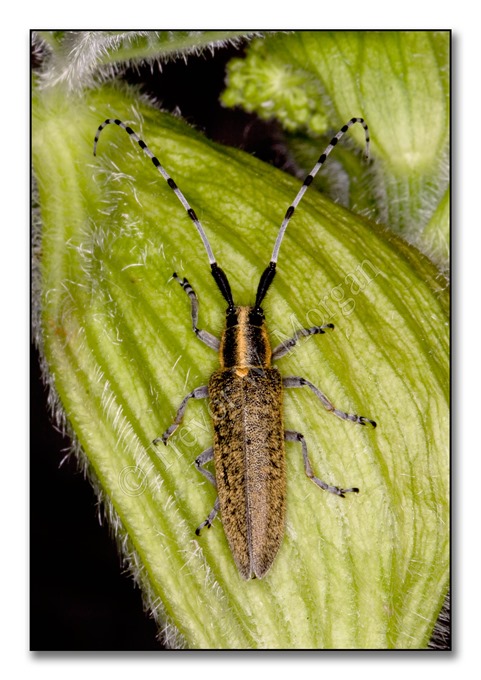 Golden-bloomed Grey Longhorn Beetle (Agapanthia villosoviridescens) Up to 25mm long. The yellow stripe on the back of the thorax and the yellow hairs on the elytra set this beetle apart from other large British beetles. It can be found in the Midlands and East Anglia in damp vegetation from May to July.
 Sloe Bug (Dolycoris baccarum) Up to 12mm long. I caught this shield bug egg laying out in the open in a very exposed position, I doubt that the eggs survived! Found throughout the UK along hedges and herbaceous margins where it feeds on the flowers and fruits of many plants. Contrary to it’s name it is not confined solely to Sloe bushes.
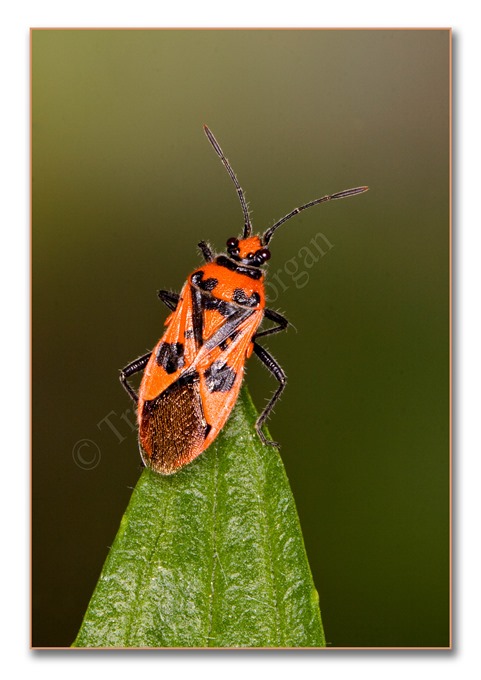 Black and Red Squash Bug (Corizus hyosciami) A member of the Shield Bug family this strikingly colourful bug frequents a large variety of plants, originally only found in sandy coastal areas of southern Britain it is increasingly being recorded inland throughout England and Wales and as far north as Yorkshire. Careful identification is required as it can be easily confused with the red and black ground bugs.
 Phantom Cranefly (Ptychoptera contaminata) Outwardly similar to Craneflies but with some subtle diagnostic features, one of them being the long tibial spurs that are just visible on the hind legs in the photograph. It can be found from late Spring through to Autumn in any vegetated and damp water margins (the larvae are aquatic).
 (Muscid) Fly (Graphomya maculata) This female (males have an orangey brown pattern on the abdomen) is a member of the large fly family that also includes the House Fly and the Stable Fly. They are very abundant and can be found in most vegetated areas throughout Europe where they nectar on various flowers..especially on Umbellifers.
 Dance Fly (Empis tessellata) Up to 12mm long. This is a predator fly, it uses it’s rigid downward-pointing proboscis to spear it’s prey, mostly other flies. Found from April to August in most open habitats where it frequents the larger flower heads. It is very similar to and is often confused with Robber-flies.
 Mayfly (ephemera vulgata) Mayflies are aquatic insects, the ‘nymphs’ live in fresh water, but in early Spring the fully winged adults emerge, sometimes in large numbers…and not always in May! with the sole aim of finding a mate as quickly as possible, the life span of an adult is only around one to two days. The first part of it’s binomial name comes from the Greek ephemerus which means short lived or literally ‘lasting a day’.
That’s all folks! (for now anyway!!) I hope you found something of interest and didn’t get too bored?
As always any comments or observations will be greatly appreciated.
Mayfly (ephemera vulgata) Mayflies are aquatic insects, the ‘nymphs’ live in fresh water, but in early Spring the fully winged adults emerge, sometimes in large numbers…and not always in May! with the sole aim of finding a mate as quickly as possible, the life span of an adult is only around one to two days. The first part of it’s binomial name comes from the Greek ephemerus which means short lived or literally ‘lasting a day’.
That’s all folks! (for now anyway!!) I hope you found something of interest and didn’t get too bored?
As always any comments or observations will be greatly appreciated.
As you will have noticed from my last post I’ve been trying out a new way (for me) of photographing bugs. When I’ve been out walking and spotted any bugs, instead of photographing them ‘in situ’, I’ve captured a few in pots and brought them home to photograph on a plain white background. I’ve still not perfected the technique but I think it does help to show up more of the intricate details and colours that you would not necessarily see in a ‘standard’ photograph…..I’ll be interested to read your thoughts and comments!
 Crucifer Shield Bug / Brassica Bug (Eurydema oleracea) At 7mm long x 4mm wide this widespread and fairly common little bug is found in a wide variety of habitats and as it’s name suggests is mostly associated with, where it feeds on the flowers and is classed as a pest, cruciferous plants such as cabbage, radish, turnip, oil seed rape and nasturtiums as well as wild cruciferous plants. It comes in a number of colour forms..black with white spots is the most common form but the spots can also be yellow (young adult)…..
…or red.
Crucifer Shield Bug / Brassica Bug (Eurydema oleracea) At 7mm long x 4mm wide this widespread and fairly common little bug is found in a wide variety of habitats and as it’s name suggests is mostly associated with, where it feeds on the flowers and is classed as a pest, cruciferous plants such as cabbage, radish, turnip, oil seed rape and nasturtiums as well as wild cruciferous plants. It comes in a number of colour forms..black with white spots is the most common form but the spots can also be yellow (young adult)…..
…or red.

 Green Dock Beetle (Gastrophysia viridula) This 4mm-6mm long green beetle often has a golden or bluish sheen. It is commonly found on the leaves of the Dock plant, the larval food plant, from May to June throughout the UK. The female's body becomes very swollen when filled with the bright orange eggs which she lays in clusters on the underside of the Dock leaves …
…a greener one!
Green Dock Beetle (Gastrophysia viridula) This 4mm-6mm long green beetle often has a golden or bluish sheen. It is commonly found on the leaves of the Dock plant, the larval food plant, from May to June throughout the UK. The female's body becomes very swollen when filled with the bright orange eggs which she lays in clusters on the underside of the Dock leaves …
…a greener one!

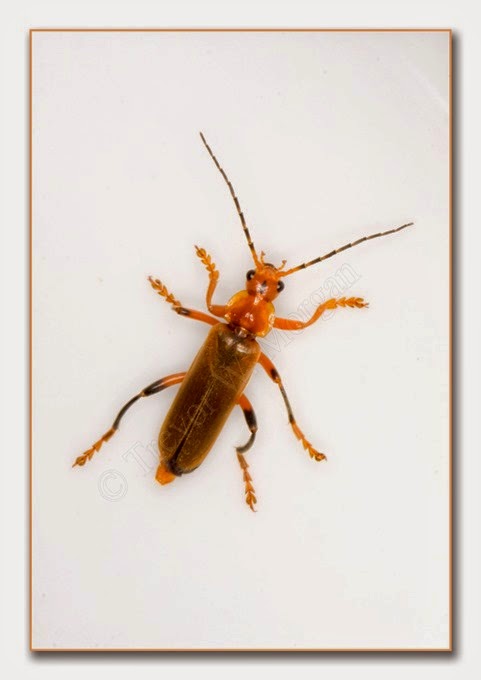
 Soldier Beetle (Cantharis livida) At 10mm to 15mm long this is one of the more commonly seen Soldier Beetles of the 40 or so species found in the UK. In the summer months they can be found, sometimes in large numbers, on thistles and umbelliferous flowers.
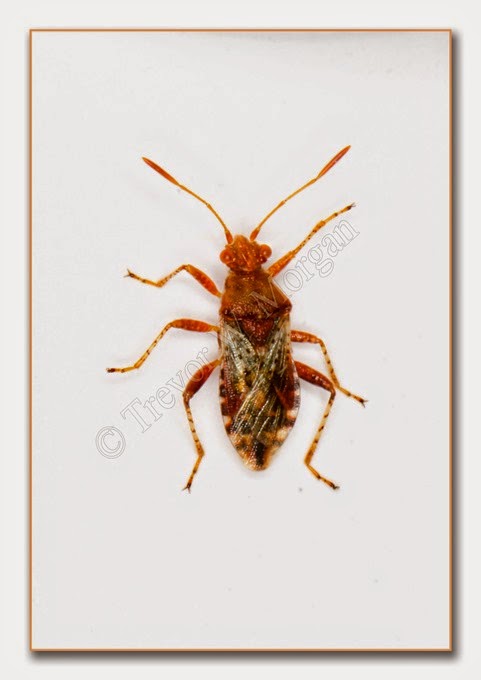 Scentless Plant Bug (Rhopalus subrufus) This 7mm long close relative of Squash Bugs is widely found in woodland clearings and low scrubby areas in the southern parts of the UK where it is associated with a great variety of plants but tends to favour St. Johns-wort (Hypericum perforatum).
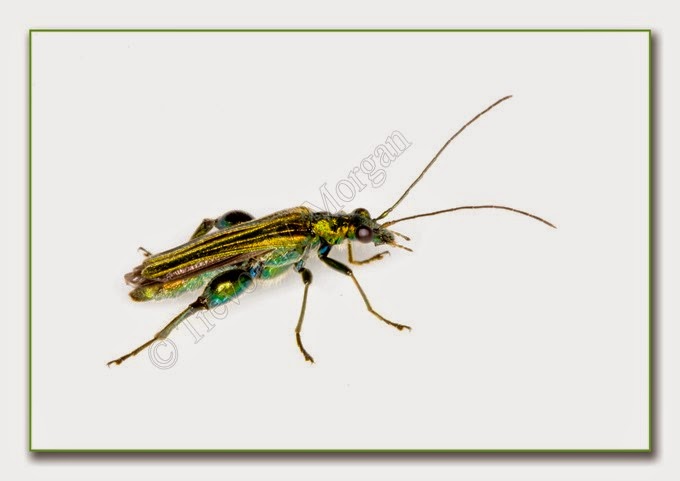 Thick-Legged Flower Beetle (Oedemera nobilis) This 10mm long beetle is found in most habitats throughout the UK but is more abundant in the southern parts. It feeds on the flower pollen from April to September. It’s the male only that has the swollen thighs from where it gets some of it’s other descriptive names such as..Fat Legged Beetle and Swollen Thighed Beetle.
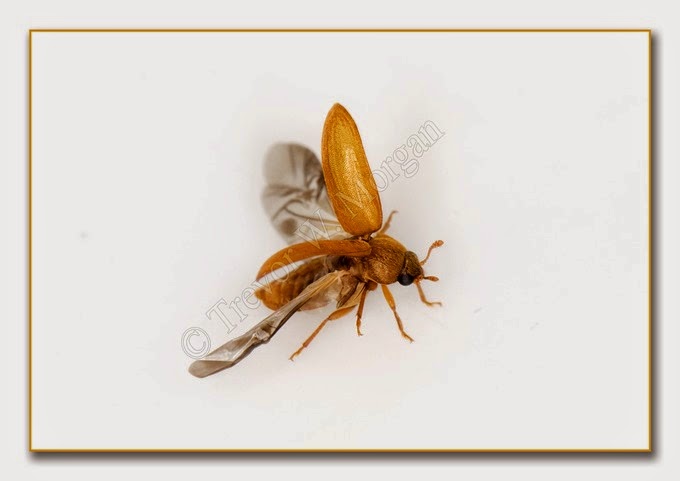
 Raspberry Beetle (Byturus tomentosus) Part of the fruitworm family this 4mm long beetle is classed as a pest in most parts of Northern Europe where it lays it’s eggs in the flowers of both wild and cultivated raspberry, loganberry and blackberry plants, the resulting larvae then feed on and destroy the developing fruit.
Take off…
Raspberry Beetle (Byturus tomentosus) Part of the fruitworm family this 4mm long beetle is classed as a pest in most parts of Northern Europe where it lays it’s eggs in the flowers of both wild and cultivated raspberry, loganberry and blackberry plants, the resulting larvae then feed on and destroy the developing fruit.
Take off…
 Nettle Weevil (Phyllobius pomaceus) This 9mm long beetle is covered in metallic green scales however, these are easily rubbed off as the beetle gets older leaving it with a black appearance. Notice the large ‘tooth’ on the front femurs. Found from April to June, as it’s name suggests, on nettles throughout most of the UK except in Scotland where it is scarce.
Another flier!..
Nettle Weevil (Phyllobius pomaceus) This 9mm long beetle is covered in metallic green scales however, these are easily rubbed off as the beetle gets older leaving it with a black appearance. Notice the large ‘tooth’ on the front femurs. Found from April to June, as it’s name suggests, on nettles throughout most of the UK except in Scotland where it is scarce.
Another flier!..
 NB…After photographing them all the bugs were returned to the area where I found them and released…except the Raspberry Beetle which somehow disappeared!!
…Yep, that’s how low I had to get when I went out and about for a couple of days last week looking to photograph some Moss, Lichen and, as it turned out, some rather special Fungus.
 I’m still not up to speed on the many different types of moss but I think this is Broom Fork-moss (Dicranum scoparium). It caught my eye as the sun was sparkling through the water droplets left over from the early morning frost although, I must confess, I didn’t make the best job of portraying that in the photograph.
Many species of moss are ‘fruiting’ at this time of year where they throw up long stalks (seta) topped by strikingly colourful seed capsules (sporangium).
I’m still not up to speed on the many different types of moss but I think this is Broom Fork-moss (Dicranum scoparium). It caught my eye as the sun was sparkling through the water droplets left over from the early morning frost although, I must confess, I didn’t make the best job of portraying that in the photograph.
Many species of moss are ‘fruiting’ at this time of year where they throw up long stalks (seta) topped by strikingly colourful seed capsules (sporangium).
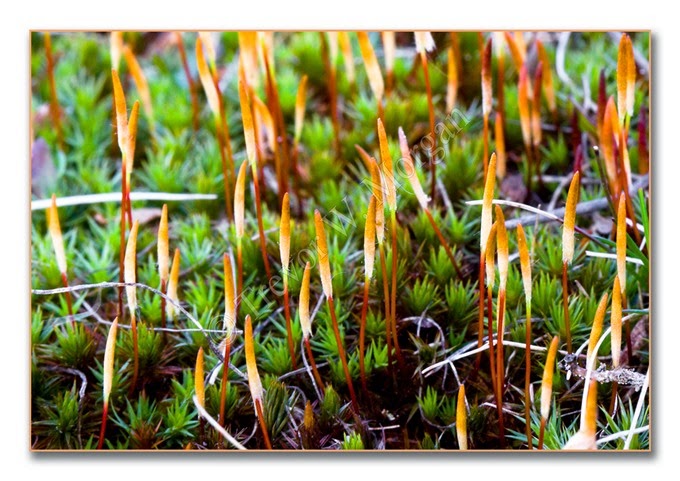
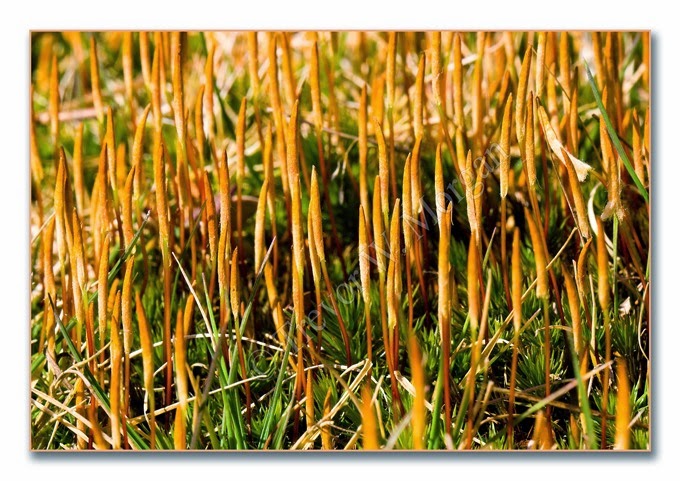 Strict Haircap (Polytrichum strictum)
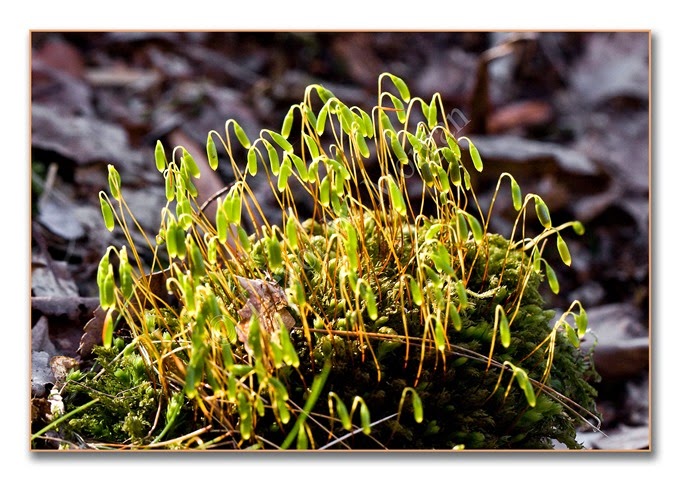 Capillary Thread-moss (Bryum capillare). The seed capsules of this common moss will turn a dark red colour as they ripen.
Next up (or should I say down!) are these three different looking Lichens, or to be more accurate Lichenised fungi. If you want to give your brain a bit of a work out and learn more about what Lichenised fungi are..have a look here
Capillary Thread-moss (Bryum capillare). The seed capsules of this common moss will turn a dark red colour as they ripen.
Next up (or should I say down!) are these three different looking Lichens, or to be more accurate Lichenised fungi. If you want to give your brain a bit of a work out and learn more about what Lichenised fungi are..have a look here
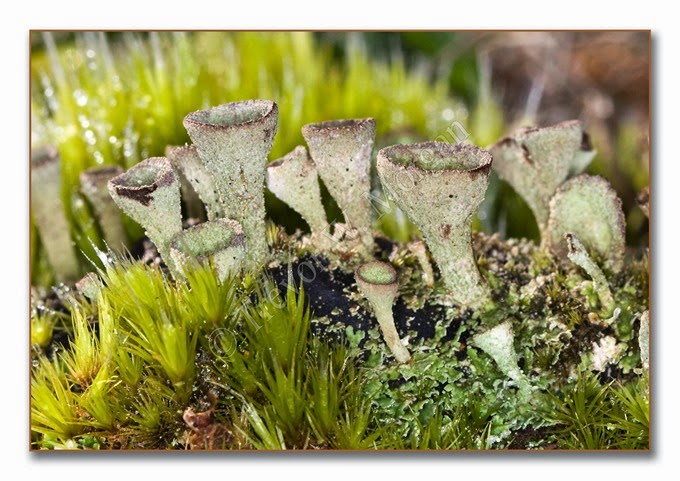
 Cladonia pyxidata with cup shaped fruiting bodies.
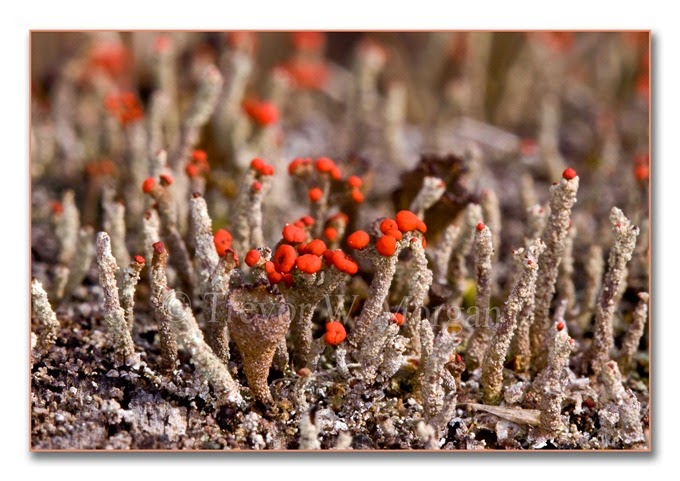
 Cladonia floerkeana with red tipped spore producing bodies.
 Cladonia uncialis with antler like branched fruiting bodies.
These three commonly seen lichens all favour heath and moorland habitats.
And now for that something rather special…..
While crawling about (yes, really!) looking for moss and lichen I encountered quite a lot of pony/horse poo, they use ponies for habitat management in this area during the winter, and on one particular ‘pile’ something small and unusual caught my eye….
Cladonia uncialis with antler like branched fruiting bodies.
These three commonly seen lichens all favour heath and moorland habitats.
And now for that something rather special…..
While crawling about (yes, really!) looking for moss and lichen I encountered quite a lot of pony/horse poo, they use ponies for habitat management in this area during the winter, and on one particular ‘pile’ something small and unusual caught my eye….
 …I instantly recognised it as Nail Fungus (Poronia punstata) a small quite rare and declining fungi that only grows on the dung of horses and ponies. This aptly named fungus that, when young, closely resembles a small rusty brown nail will grow to around 80mm tall with a cap diameter of 15mm.
As you can imagine I was rather pleased to find this little gem and so far it’s got to be the highlight of my nature watching year. (yeh, I know I’m a bit sad!)
So, the next time you’re out and about and you come across some old piles of horse poo give it a closer look…you never know what you might find?
…I instantly recognised it as Nail Fungus (Poronia punstata) a small quite rare and declining fungi that only grows on the dung of horses and ponies. This aptly named fungus that, when young, closely resembles a small rusty brown nail will grow to around 80mm tall with a cap diameter of 15mm.
As you can imagine I was rather pleased to find this little gem and so far it’s got to be the highlight of my nature watching year. (yeh, I know I’m a bit sad!)
So, the next time you’re out and about and you come across some old piles of horse poo give it a closer look…you never know what you might find?
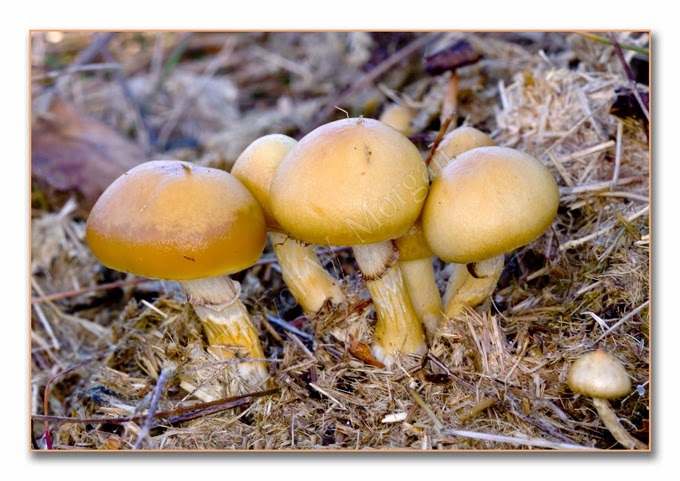 Also growing through some horse dung I found these Yellow Webcap (Cortinarius delibutus). This widespread but uncommon fungi is associated with mixed woodland and grows to around 100mm tall with a cap dia of 80mm.
 This is all that’s left of one of last years Meadow Puffball (Lycoperdon pratense)..a fragile, hollow paper like shell.
Did I mention a snake’s belly? Well….
…less than ten feet from where I’d earlier been laying prone on the ground taking photos of the Nail Fungus I came across three of these…
This is all that’s left of one of last years Meadow Puffball (Lycoperdon pratense)..a fragile, hollow paper like shell.
Did I mention a snake’s belly? Well….
…less than ten feet from where I’d earlier been laying prone on the ground taking photos of the Nail Fungus I came across three of these…
 Adder (Vipera berus) basking in the mid morning sunshine. Not easy to get a clear photograph though as they were partly concealed by the heather and bracken.
Spring is slowly arriving and nature is starting to ‘wake up’ after it’s winter slumbers and hopefully there’ll be many more photo opportunities over the next few weeks….take care and have a good one.
Adder (Vipera berus) basking in the mid morning sunshine. Not easy to get a clear photograph though as they were partly concealed by the heather and bracken.
Spring is slowly arriving and nature is starting to ‘wake up’ after it’s winter slumbers and hopefully there’ll be many more photo opportunities over the next few weeks….take care and have a good one.


