In this second instalment of the series I’m again looking back at some of the photographs I’ve taken over the past year, still on the theme of moths but this time looking at some of the larger types of ‘day fliers’.
Day Flying Moths (part 2)
Just to recap…..What determines a day flying moth? Some moths are quite obviously day fliers, flying whenever the sun shines, just like butterflies. Others, that don’t normally fly by day, will readily take to the wing on being disturbed from their roosting site as we walk through the grass or brush against bushes etc.
Cream Wave (Scopula floslactata) (1693)
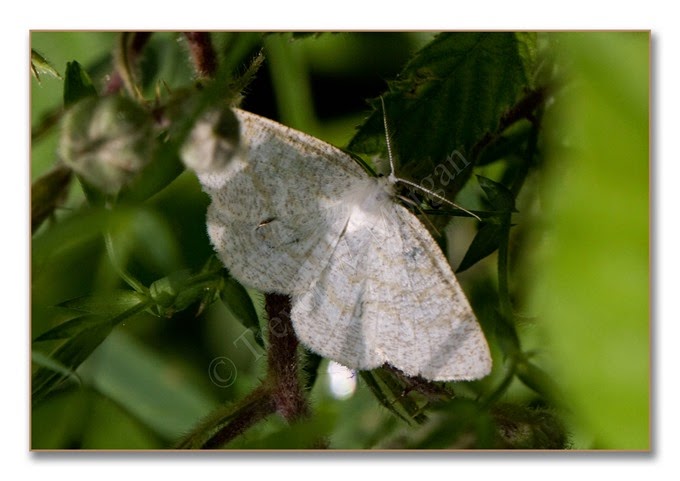 (Not the best of photographs!) With a wingspan of 30mm..this moth can be found in broadleaved woodland, hedgerows and on damp rough grassland during May and June. It is common and well distributed in England and Wales but less well represented in the rest of the country.
Silver-ground Carpet (Xanthorhoe montanata) (1727)
(Not the best of photographs!) With a wingspan of 30mm..this moth can be found in broadleaved woodland, hedgerows and on damp rough grassland during May and June. It is common and well distributed in England and Wales but less well represented in the rest of the country.
Silver-ground Carpet (Xanthorhoe montanata) (1727)
 This large moth has a wingspan of 34mm and can be seen flying at dusk, although it is easily disturbed into flight during the day, during mid May to late July. It prefers a damp habitat with tall herbaceous vegetation such as hedgerows, woodland rides, chalk downlands, fens and heathlands.
Garden Carpet (Xanthorhoe fluctuata) (1728)
This large moth has a wingspan of 34mm and can be seen flying at dusk, although it is easily disturbed into flight during the day, during mid May to late July. It prefers a damp habitat with tall herbaceous vegetation such as hedgerows, woodland rides, chalk downlands, fens and heathlands.
Garden Carpet (Xanthorhoe fluctuata) (1728)
 Another `carpet moth’…this one is very common and, as it’s name suggests, can be found in gardens, allotments and rough urban areas. It has a wingspan of 32mm and will readily take to flight if disturbed although it normally flies at dusk from April to October. It can often be found perched in the open on garden walls/fences during the day.
The one in the photograph above flew through the open patio doors into my living room one warm early June evening.
Chalk Carpet (Scotopteryx bipunctaria) (1731)
Another `carpet moth’…this one is very common and, as it’s name suggests, can be found in gardens, allotments and rough urban areas. It has a wingspan of 32mm and will readily take to flight if disturbed although it normally flies at dusk from April to October. It can often be found perched in the open on garden walls/fences during the day.
The one in the photograph above flew through the open patio doors into my living room one warm early June evening.
Chalk Carpet (Scotopteryx bipunctaria) (1731)
 The Chalk Carpet is distinguished from other carpet moths by it’s drab grey colour and the two small black dots on each forewing. Listed as nationally scarce, it is found locally across much of the south of England and Wales on chalk grassland and in old quarries. During the daytime it rests on bare chalk or soil where it can be easily disturbed. It has a wingspan of 36mm and a flight period from July to August.
Common Carpet (Epirrhoe sternata) (1738)
The Chalk Carpet is distinguished from other carpet moths by it’s drab grey colour and the two small black dots on each forewing. Listed as nationally scarce, it is found locally across much of the south of England and Wales on chalk grassland and in old quarries. During the daytime it rests on bare chalk or soil where it can be easily disturbed. It has a wingspan of 36mm and a flight period from July to August.
Common Carpet (Epirrhoe sternata) (1738)
 As it’s name suggests this moth is common in most types of habitat throughout the UK. It has two flight periods the main one is from May to June and another, with fewer moths on the wing, from July to early September. It flies from dusk onwards when it also settles to feed on flowers such as Ragwort. It is easily spooked into flight during the day and has a wingspan of 28mm.
Yellow Shell (Camptogramma bilineata) (1742)
As it’s name suggests this moth is common in most types of habitat throughout the UK. It has two flight periods the main one is from May to June and another, with fewer moths on the wing, from July to early September. It flies from dusk onwards when it also settles to feed on flowers such as Ragwort. It is easily spooked into flight during the day and has a wingspan of 28mm.
Yellow Shell (Camptogramma bilineata) (1742)
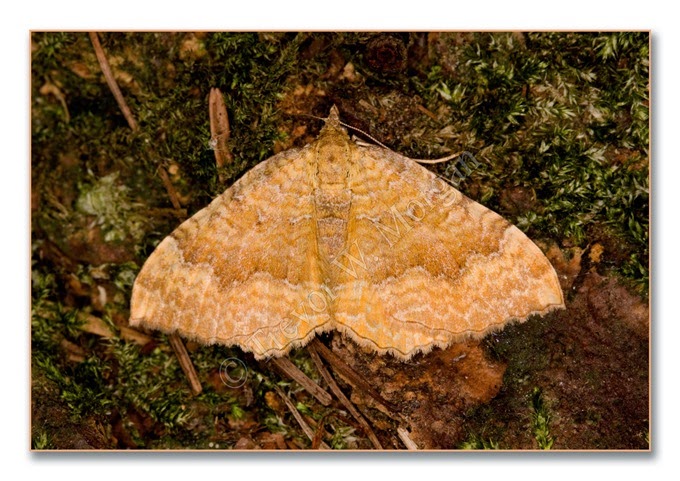 This distinctive orange/brown moth (bright yellow forms have also been recorded) is common across the UK and can be found in lowland fields, meadows, along hedgerows and also in gardens. With a wingspan of 32mm it has a flight period from June to August. In the right habitat large numbers can be seen flying at dusk but if disturbed will readily take to the wing during the day.
The next two moths are the two most commonly seen members of the seven strong species of Burnet Moth that occur in the UK. The differences between all seven are very small and mainly come down to the variations in the red spot markings on the wings, these also act as a warning to any would be predators that they are toxic. Varied habitat preferences and distribution are also an aid in their identification.
They are both day flying moths (they don’t fly at night) and can usually be seen in good numbers on bright sunny days.
Five-spot Burnet (Zygaena trifolii ssp. palustrella) (170)
This distinctive orange/brown moth (bright yellow forms have also been recorded) is common across the UK and can be found in lowland fields, meadows, along hedgerows and also in gardens. With a wingspan of 32mm it has a flight period from June to August. In the right habitat large numbers can be seen flying at dusk but if disturbed will readily take to the wing during the day.
The next two moths are the two most commonly seen members of the seven strong species of Burnet Moth that occur in the UK. The differences between all seven are very small and mainly come down to the variations in the red spot markings on the wings, these also act as a warning to any would be predators that they are toxic. Varied habitat preferences and distribution are also an aid in their identification.
They are both day flying moths (they don’t fly at night) and can usually be seen in good numbers on bright sunny days.
Five-spot Burnet (Zygaena trifolii ssp. palustrella) (170)
 Very similar in appearance to the Narrow-bordered Five-spot Burnet (Zygaena lonicerae) (171) but is likely to have it’s two central red spots closer or merging together. They also have different habitats with the Five-spot preferring chalk downland. It has a wingspan of 38mm and a flight period from June to August.
Six-spot Burnet (Zygaena filipendulae) (169)
Very similar in appearance to the Narrow-bordered Five-spot Burnet (Zygaena lonicerae) (171) but is likely to have it’s two central red spots closer or merging together. They also have different habitats with the Five-spot preferring chalk downland. It has a wingspan of 38mm and a flight period from June to August.
Six-spot Burnet (Zygaena filipendulae) (169)
 This most commonly found member of the Burnet family is abundant throughout the UK, although a little scarcer in Scotland. On warm sunny days it can bee seen flitting, just like a butterfly, from flower to flower on almost any grassland where the preferred flowers are those of thistles and knapweed. It is a similar size and has the same flight period as the Five-spot Burnet above.
Moving away from macro moths to a member of the very similar and closely related micro moth group known as the grass-moths..
Garden Grass-veneer (Chrysoteuchia culmella) (1293)
This most commonly found member of the Burnet family is abundant throughout the UK, although a little scarcer in Scotland. On warm sunny days it can bee seen flitting, just like a butterfly, from flower to flower on almost any grassland where the preferred flowers are those of thistles and knapweed. It is a similar size and has the same flight period as the Five-spot Burnet above.
Moving away from macro moths to a member of the very similar and closely related micro moth group known as the grass-moths..
Garden Grass-veneer (Chrysoteuchia culmella) (1293)
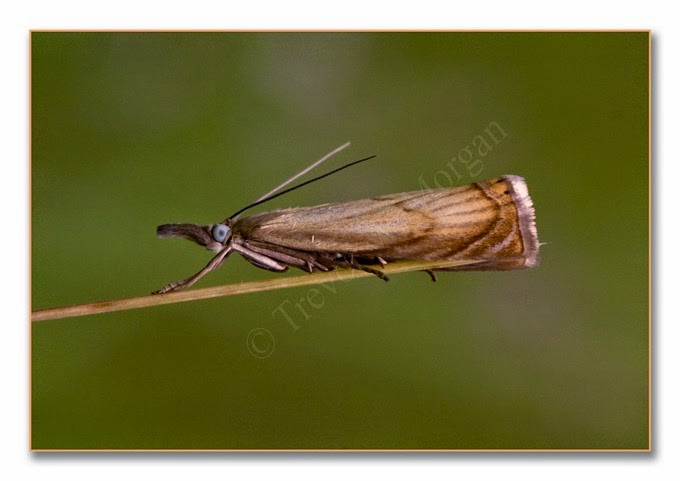 There are many different grass moths of which some are widespread and very common and can often be seen in large numbers. They rest with their wings held in a tent like position over their bodies with the antennae swept back. As their name suggests they are found in grassy areas.
The Garden Grass-veneer is distinguished from the other members of the group by the metallic fringe on the end, and the elbowed cross-line toward the rear, of the forewing. It is easily disturbed into a fluttering flight from its resting place on long grass stems in meadows, chalk grasslands and waste ground. It has a flight period from May to September and a wing length of up to 12mm.
There are many different grass moths of which some are widespread and very common and can often be seen in large numbers. They rest with their wings held in a tent like position over their bodies with the antennae swept back. As their name suggests they are found in grassy areas.
The Garden Grass-veneer is distinguished from the other members of the group by the metallic fringe on the end, and the elbowed cross-line toward the rear, of the forewing. It is easily disturbed into a fluttering flight from its resting place on long grass stems in meadows, chalk grasslands and waste ground. It has a flight period from May to September and a wing length of up to 12mm.
As the weather closes in for winter and the days get shorter and darker and so making it more difficult (and less enjoyable) to get out with the camera I thought that it was time to knuckle down and do a series of posts showing some of the photographs that I’ve taken over the past few months.
So, here’s the first instalment…I hope you don’t get bored?
Day Flying Moths (part 1)
What determines a day flying moth? Some moths are quite obviously day fliers, flying whenever the sun shines, just like butterflies. Others, that don’t normally fly by day, will readily take to the wing on being disturbed from their roosting site as we walk through the grass or brush against bushes etc.
Common Tubic (Alabonia geoffrella) (656)
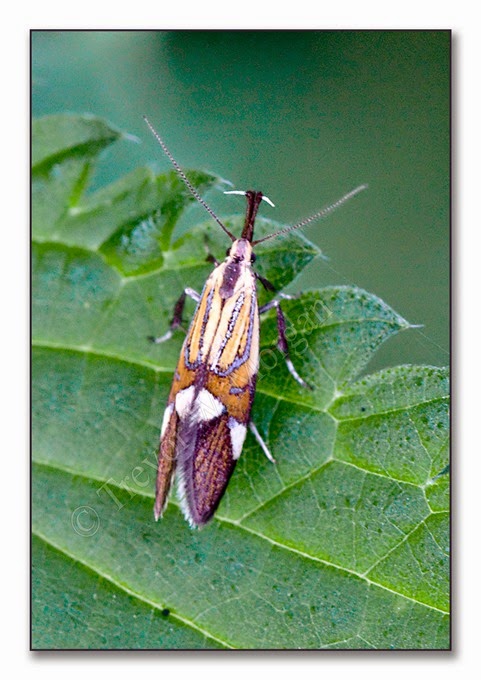 A micro moth with a wingspan of 20mm. Flies during early morning sunshine from May to June and can be found in deciduous woodland and along hedgerows and areas of scrub.
Common Nettle-tap (Anthophila fabriciana) (385)
A micro moth with a wingspan of 20mm. Flies during early morning sunshine from May to June and can be found in deciduous woodland and along hedgerows and areas of scrub.
Common Nettle-tap (Anthophila fabriciana) (385)
 This very abundant, it can be found throughout the world, micro moth has a wingspan of 15mm and as it’s name suggests can be found anywhere that nettles grow. On the day I took this picture there were hundreds of them, swarming over every Tansy (Tanacetum vulgare) plant that I walked past. They fly from April to November.
Small Barred Long-horn (Adela croesella) (151)
This very abundant, it can be found throughout the world, micro moth has a wingspan of 15mm and as it’s name suggests can be found anywhere that nettles grow. On the day I took this picture there were hundreds of them, swarming over every Tansy (Tanacetum vulgare) plant that I walked past. They fly from April to November.
Small Barred Long-horn (Adela croesella) (151)
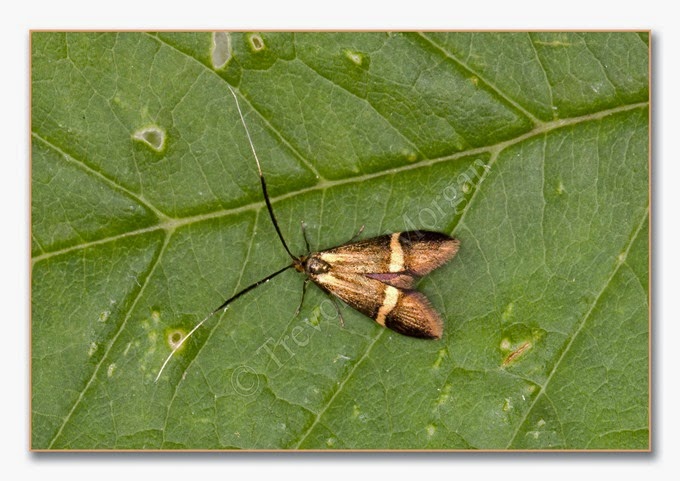 This tiny micro moth has a wingspan of around 13mm and can be seen flying on sunny days during May to June. It’s antenna are slightly longer than the wings. It can be found in a variety of habitats including woodland margins, scrubland, fens and marshes.
Yellow-barred Long-horn (Nemophora degeerella) (148)
This tiny micro moth has a wingspan of around 13mm and can be seen flying on sunny days during May to June. It’s antenna are slightly longer than the wings. It can be found in a variety of habitats including woodland margins, scrubland, fens and marshes.
Yellow-barred Long-horn (Nemophora degeerella) (148)
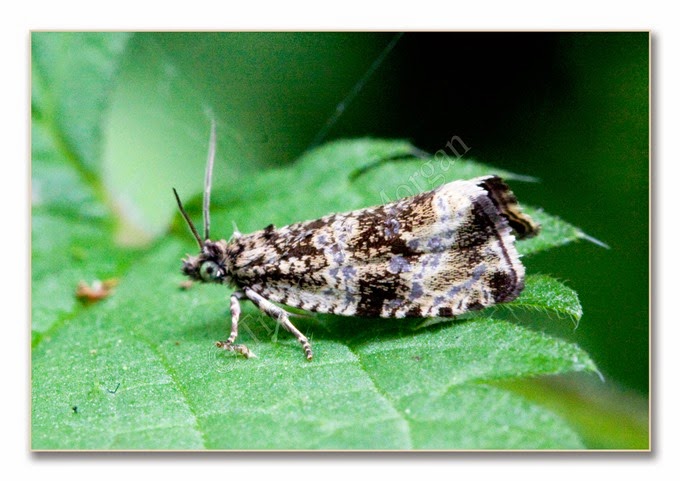
 This micro moth is common in England and Wales and flies in dappled shade and at dusk from May to July. It’s long antenna are almost four times the length of the males 10mm long forewing. It can be found in (damp) woodland, hedgerows, fens and marshes.
Common Marble (Celypha lacunana) (1076)
This micro moth is common in England and Wales and flies in dappled shade and at dusk from May to July. It’s long antenna are almost four times the length of the males 10mm long forewing. It can be found in (damp) woodland, hedgerows, fens and marshes.
Common Marble (Celypha lacunana) (1076)
 This common micro moth is readily disturbed from it’s roosting place during the day. It’s wingspan is around 20mm and it flies from May to early November. It has a wide ranging habitat from woodland and hedgerows to meadows, marshes, roadside verges and gardens.
Small Purple and Gold (Mint Moth) (Pyrausta aurata) (1361)
This common micro moth is readily disturbed from it’s roosting place during the day. It’s wingspan is around 20mm and it flies from May to early November. It has a wide ranging habitat from woodland and hedgerows to meadows, marshes, roadside verges and gardens.
Small Purple and Gold (Mint Moth) (Pyrausta aurata) (1361)
 A very common micro moth, except in Scotland where it’s rare. It has a wingspan of 18mm and flies in sunshine from March to early September. Can be found on chalk and limestone grassland and in gardens and wetlands especially were there is an abundance of it’s food plant..Mint, Calamint and Marjoram, hence it’s secondary name.
Common Purple and Gold (pyrausta purpuralis) (1362)
A very common micro moth, except in Scotland where it’s rare. It has a wingspan of 18mm and flies in sunshine from March to early September. Can be found on chalk and limestone grassland and in gardens and wetlands especially were there is an abundance of it’s food plant..Mint, Calamint and Marjoram, hence it’s secondary name.
Common Purple and Gold (pyrausta purpuralis) (1362)
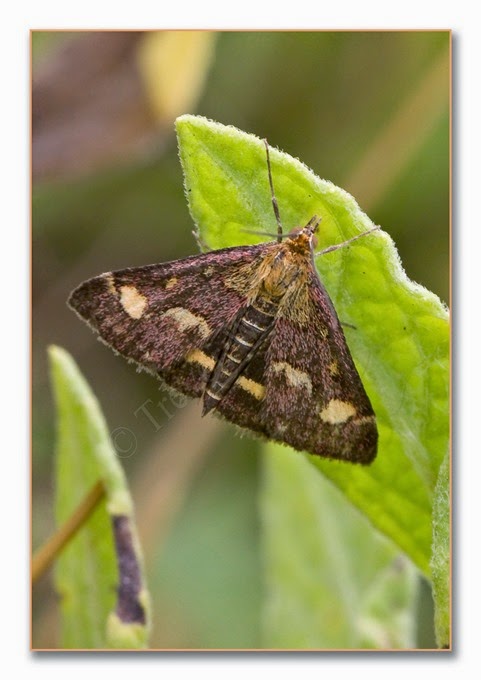 Similar to p.auralis above but the gold band across the wing is usually split into three and the wingspan is slightly bigger at 22mm. It is also found in the same habitat and flies in sunshine and at night from late March to early September.
Wavy-barred Sable (Pyrausta nigrata) (1366)
Similar to p.auralis above but the gold band across the wing is usually split into three and the wingspan is slightly bigger at 22mm. It is also found in the same habitat and flies in sunshine and at night from late March to early September.
Wavy-barred Sable (Pyrausta nigrata) (1366)
 Again similar to the two moths above but instead of being predominantly purple the 8mm long wings are black. It flies in sunshine from mid April to October and can be found on chalk grassland.
Common Heath (Ematurga atomaria) (1952)
Again similar to the two moths above but instead of being predominantly purple the 8mm long wings are black. It flies in sunshine from mid April to October and can be found on chalk grassland.
Common Heath (Ematurga atomaria) (1952)
 A macro moth that flies by day especially when it’s been disturbed from it’s resting place in the long grass on heathland, moorland or chalk meadows. Flies between May and June and sometimes as late as August. It is very variable in colour and pattern and has a wingspan of 30mm.
Clouded Silver (Lomographa temerata) (1958)
A macro moth that flies by day especially when it’s been disturbed from it’s resting place in the long grass on heathland, moorland or chalk meadows. Flies between May and June and sometimes as late as August. It is very variable in colour and pattern and has a wingspan of 30mm.
Clouded Silver (Lomographa temerata) (1958)
 This macro moth flies at dusk, from May to early July, but will also take to the wing if disturbed during the day. Habitat includes woodland, parks, scrubland, hedgerows and sometimes urban gardens. It is quite a large moth with a wingspan of 33mm.
Cinnabar (Tyria jacobaeae) (2069)
This macro moth flies at dusk, from May to early July, but will also take to the wing if disturbed during the day. Habitat includes woodland, parks, scrubland, hedgerows and sometimes urban gardens. It is quite a large moth with a wingspan of 33mm.
Cinnabar (Tyria jacobaeae) (2069)
 The red and black markings of this moth make it easy to spot. It is widely distributed, and flies in the sunshine from mid May to early August in open habitats including well drained rabbit grazed grasslands, sand-dunes and heathland. It’s long flight period means that you often see adults on the wing next to the distinctively marked (black and gold hoops) fully grown caterpillars that can be seen feeding on Common Ragwort (Senecio jacobaea). This is a large moth with a wingspan of 46mm.
Burnet Companion (Euclidia glyphica) (2463)
The red and black markings of this moth make it easy to spot. It is widely distributed, and flies in the sunshine from mid May to early August in open habitats including well drained rabbit grazed grasslands, sand-dunes and heathland. It’s long flight period means that you often see adults on the wing next to the distinctively marked (black and gold hoops) fully grown caterpillars that can be seen feeding on Common Ragwort (Senecio jacobaea). This is a large moth with a wingspan of 46mm.
Burnet Companion (Euclidia glyphica) (2463)
 Another large moth, with a wingspan of 30mm, can be seen flying on sunny and warm overcast days. It normally only flies for short distances where it will settle with it’s forewings slightly open exposing the bright orange ‘flash’ on the hind wings. The flight period is from mid May to early July in calcareous grassland including flower rich meadows, woodland rides and embankments.
Straw Dot (Rivula sericealis) (2474)
Another large moth, with a wingspan of 30mm, can be seen flying on sunny and warm overcast days. It normally only flies for short distances where it will settle with it’s forewings slightly open exposing the bright orange ‘flash’ on the hind wings. The flight period is from mid May to early July in calcareous grassland including flower rich meadows, woodland rides and embankments.
Straw Dot (Rivula sericealis) (2474)
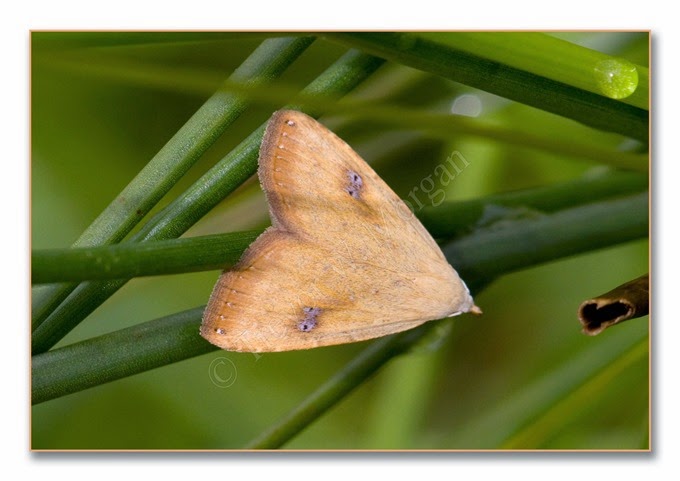 Another ‘night flier’ that is easily disturbed by day this macro moth has a wingspan of 30mm. In the south of England (south of Yorkshire) it has two flight periods from June to July and August to October. Further north it only flies between June and August. It’s preferred habitat is tall damp grassland, marshes, fens and heathlands.
Chimney Sweeper (Odezia atrata) (1870)
Another ‘night flier’ that is easily disturbed by day this macro moth has a wingspan of 30mm. In the south of England (south of Yorkshire) it has two flight periods from June to July and August to October. Further north it only flies between June and August. It’s preferred habitat is tall damp grassland, marshes, fens and heathlands.
Chimney Sweeper (Odezia atrata) (1870)
 This large moth, with a wingspan of 30mm, gets it’s name from it’s entirely black colouring (except for the white fringe around the tip of the forewings when newly emerged). More common in the north of the country it only occurs locally in the south where it’s preferred habitat is chalk downland, old hay meadows and unimproved grassy areas, in the north it frequents the banks of streams and other damp places. It’s a strong flier but usually only flies for short distances and rarely settles for any length of time, making it rather difficult to photograph! The flight period only lasts from June to July.
I hope you found this post interesting and I think you’ll agree that, although they are not as conspicuous, the colour and variety of our moths compares well with that of our butterflies?
In part 2 I’ll feature some of our larger day flying moths.
This large moth, with a wingspan of 30mm, gets it’s name from it’s entirely black colouring (except for the white fringe around the tip of the forewings when newly emerged). More common in the north of the country it only occurs locally in the south where it’s preferred habitat is chalk downland, old hay meadows and unimproved grassy areas, in the north it frequents the banks of streams and other damp places. It’s a strong flier but usually only flies for short distances and rarely settles for any length of time, making it rather difficult to photograph! The flight period only lasts from June to July.
I hope you found this post interesting and I think you’ll agree that, although they are not as conspicuous, the colour and variety of our moths compares well with that of our butterflies?
In part 2 I’ll feature some of our larger day flying moths.


 The Chalk Carpet is distinguished from other carpet moths by it’s drab grey colour and the two small black dots on each forewing. Listed as nationally scarce, it is found locally across much of the south of England and Wales on chalk grassland and in old quarries. During the daytime it rests on bare chalk or soil where it can be easily disturbed. It has a wingspan of 36mm and a flight period from July to August.
 This distinctive orange/brown moth (bright yellow forms have also been recorded) is common across the UK and can be found in lowland fields, meadows, along hedgerows and also in gardens. With a wingspan of 32mm it has a flight period from June to August. In the right habitat large numbers can be seen flying at dusk but if disturbed will readily take to the wing during the day.


