Showing posts with label Blue-tailed. Show all posts

Monday, 19 May 2014

Early Damsels and a pair of Dragons.


The last few days have been sunny and pleasantly warm, even quite hot at times!
So, making the most of the good weather, I’ve been out and about taking photographs of the newly emerging wild flowers, butterflies, damselflies and dragonflies. It’s been noticeable over the last week or so, with the warmth of the sun (and a well watered spring!!), how the the countryside has taken on a new lushness of growth and colour.

The ‘early’ damselflies and dragonflies have started to take to the wing now…

Banded Demoiselle (calopteryx splendens)….The males are very territorial and will fight off anything that flies into their patch. They also ‘court’ the females by flicking their wings open and performing an aerial dance in front of them.
Dams and Drags 1  BD Male
Dams and Drags 2  BD
Male

Azure Damselfly (coenagrion puella)….One of the two most common blue damselflies, confusingly the females are mostly green with black on top of the abdomen.
Dams and Drags 3  AZ
                          Male

Large Red Damselfly (pyrrhosoma nymphula)….One of the very first to emerge in the spring and quite widespread but avoids fast flowing water. The males, which appear in greater numbers than the females, are aggressive and very territorial.
Dams and Drags 4  LR
                         Male

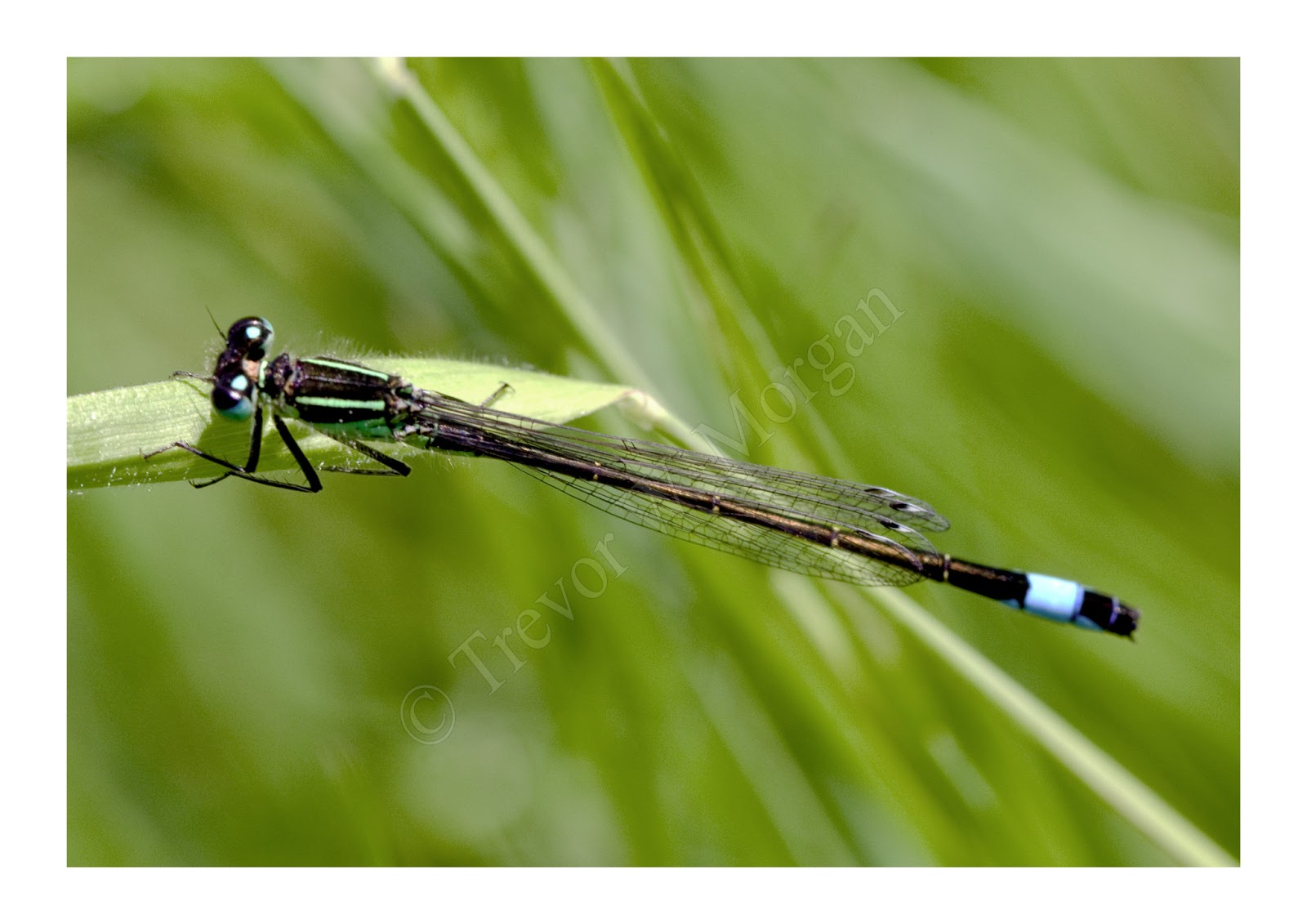
Blue-tailed Damselfly (ischnura elegans)….Another quite common damselfly. always found close to water, unlike some of the other damselflies which can roam widely. The females come in a variety of colours from green through violet to blue.
Dams and Drags 5  Bt
Male

When damselflies and dragonflies emerge as adults they first go through a stage where they are known as tenerals. During this stage which, depending on the species, can last from a few days to a few weeks their wings remains ‘milky’ and reflective and their flight is weak and fluttery. And to make identification a little difficult they lack the colouring of the adult and appear pale and drab.

How the dictionary calls it…
Ten´er`al
(Zool.) Of, pertaining to, or designating, a condition assumed by the imago of certain Neuroptera, after exclusion from the pupa. In this state the insect is soft, and has not fully attained its mature colouring.


Common Blue Damselfly (enallagma cyathigerum)….The most common and widely distributed of our native damselflies. Found in association with both still and flowing water, although immatures can be found some distance away from water bodies.
Dams and Drags 6  CB tm
Teneral Male
Dams and Drags 7  CB tm
Teneral Male
Dams and Drags 8  CB tf
Teneral Female
Females, unlike other blue damselflies, can be identified by the presence of a ‘spine’ in front of the ovipositor, under section 8 of the abdomen. (it can be clearly seen in this image)
Dams and Drags 9  CB adm
Adult Male

Red-eyed Damselfly (erythromma najas)….found only in the southern part of the country it prefers large bodies of standing water with lots of floating vegetation, especially water-lilies where the male likes to ‘rest’ on the leaves while waiting for an opponent to come into range when they’ll fight over the territorial rights.

Dams and Drags 10  CB Re tm
                         Teneral Male

Hairy Dragonfly (brachytron pratense)…. The smallest of our resident hawkers and the earliest to emerge in early May and June. Found in the southern parts of the UK, where the male can be seen patrolling over clear unpolluted and well vegetated water as it searches for females while fighting off any interlopers.

Dams and Drags 12  Hry
Male

Four-spotted Chaser (libellula quadrimaculata)….Widespread over most of the country and readily identified by the ‘four’ wing spots. The male can be seen perched on a single stem of vegetation as it waits to see off any intruder, or to intercept a passing receptive female when they will briefly mate while on the wing.
Dams and Drags 11  4SP
Male


Tuesday, 9 July 2013

THE BLUE-TAILED DAMSELFLY AND HIS COLOURFUL FEMALES


The Blue-tailed Damselfly (ischnura elegans) is one of our commonest species and  is abundant from May to September in lowland habitats around still and slow-moving water. It avoids fast flowing and acidic water but is tolerant of brackish and sewage-enriched waters.


The abdomen in both sexes is mainly black on top with the exception of (segment) S8 which is blue or, brown in some females. Both sexes have two-toned wing spots (pterostigma) on the front wings, which are whitish towards the tip and twice as long as they are wide.


Male (typica)


Female (typica)


Apart from the typica form the female occurs in four other colour forms.


The violacea  form with violet sides


which will mature into the typica male type colouration or the olive-green thorax with brown S8  of the infuscans form as seen in the mating wheel (or Copula - 'in cop') below.


The rufescens form with orange - pink sides


 which will mature into the pale brown colours, with dull brown S8, of the rufescens-obsoleta form.


and seen again 'in cop' in the image below.


These are the most likely Damselflies to be observed 'in cop' as they can typically stay  in the mating wheel position for up to six hours....in some of the Dragonfly species, such as the Chasers, it can be as little as a few seconds!


* information taken from the excellent reference book... Britain's Dragonflies by Dave Smallshire and Andy Swash.  Published by WildGuides Ltd.


Wednesday, 5 June 2013

FIVE DAMSELS AND A DRAGON


With the onset of sunnier and warmer days (it's about time!) the Damselflies and Dragonflies have begun  their annual immergence. A couple of days ago I went down to the riverside to see what I could find.... 

Large Red Damselfly (male)


 Common Blue Damselfly (male)


Common Blue Damselfly (female)  The pale colour and  the not yet fully hardened wings show that this is a newly emerged  specimen. The spine under section S8 of the abdomen also denotes that this is a female. 


Blue-tailed Damselfly (female)  The female can be one of five different colour forms...this is a rufescens colour form.


 Azure Damselfly (male)


Banded Demoiselle...one of the more striking looking Damselflies! These were out in good numbers with the males constantly patrolling back and forth along the tops of the riverside vegetation looking for avaliable females and having the occasional altercation with any other male that came within close range.

 Male

I don't know if this male was protecting the bug as a future meal or if it was just coincidence that they happened to settle in the same place!


 Female


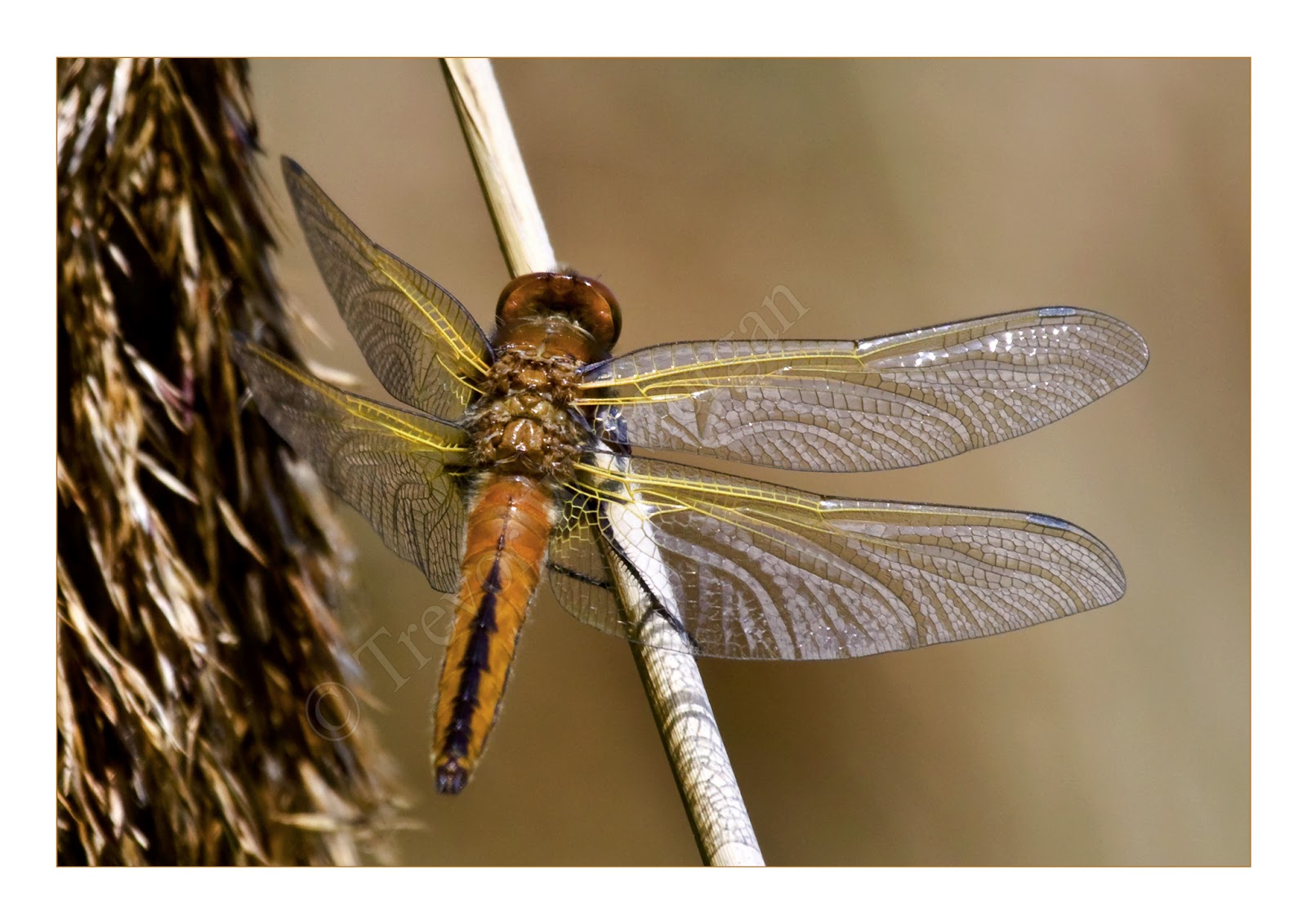
This was the only Dragonfly species that I managed to see and I found four of these newly emerging Scarce Chasers. Three flew high up into the overhanging tree branches where they could wait for their wings to harden off, luckily this one stayed low on a Reed stem and posed for a photo call! You can see that it's wings still have creases and wrinkles in them and are not yet fully hardened.


Saturday, 9 June 2012

WHEN WE HAD SUMMER


A couple of weeks ago when we had Summer, and before the Autumn like weather we're experiencing at the moment kicked in (!!), I managed to take these images of emerging Damselflies.

So, wherever you are and whatever you're doing, I hope they go some way to brighten up your day and the rest of your weekend.


Banded Demoiselle (male)


Banded Demoiselle (female)

Notice how her colour changes from iridescent Green to a metallic Gold depending on how the sun catches her.


Variable Damselfly (female)


 Common Blue Damselfly (immature male)


Scarce Blue-tailed Damselfly (coupled pair)


Red-eyed Damselfly (immature)


Azure Damselfly (female)

Azure Damselfly (coupled pair)


Large Red Damselfly (female)

Blue-tailed Damselfly (male)