Showing posts with label Chalkhill Blue. Show all posts
Tuesday, 19 July 2016
SLEEPING MARBLES
Yesterday morning I went out early, just after 4am and the temperature already up to 16°, to see if I could find some roosting butterflies in the hope that if I did find some they would be coated in dew.
It didn't take long to locate a few roosting Marbled Whites Melanargia galathea ...and yes, they did have a coating of dew, although not as much as I would have liked given that after a short walk through the long grass my boots and my trousers were already soaked through.
I also found some male Chalk Hill Blue Butterflies Lysandra coridon they seemed to be early risers and were already on the way to 'drying out'.
By 7.15am the temperature was rising (20°) in the warm sunshine and the butterflies were already taking to the wing and only briefly stopping to spread their wings and gain that little extra bit of warmth.
I also saw this roosting moth Sulpher Pearl Sitochroa palealis.
Not a bad few of hours, I got some reasonable images, a thorough soaking...and was back home in time for breakfast.
AND.......
....I also managed to get a fat hand!....I guess it's bound to happen If you go crawling about in in the long grass early in the morning, some sleepy insect is going to take offence at being woken up and is going to...BITE YOU!
Since I took these photos this morning my hand has gotten a little fatter and my forearm is now joining it, I can't fully close my hand and the 'blister' has started to weep...apart from a slight itching there isn't any pain, all I've got to remember is...DON'T SCRATCH IT! ...[;o)
Wednesday, 7 August 2013
UP CLOSE
Just a small selection of 'up close' images...
Chalkhill Blue (lysandra coridon)
Ringlet (aphantopus hyperantus)
Common Blue Damselfly (enallagma cyathigerum)
Ruddy Darter (sympetrum sanguineum)
Monday, 5 August 2013
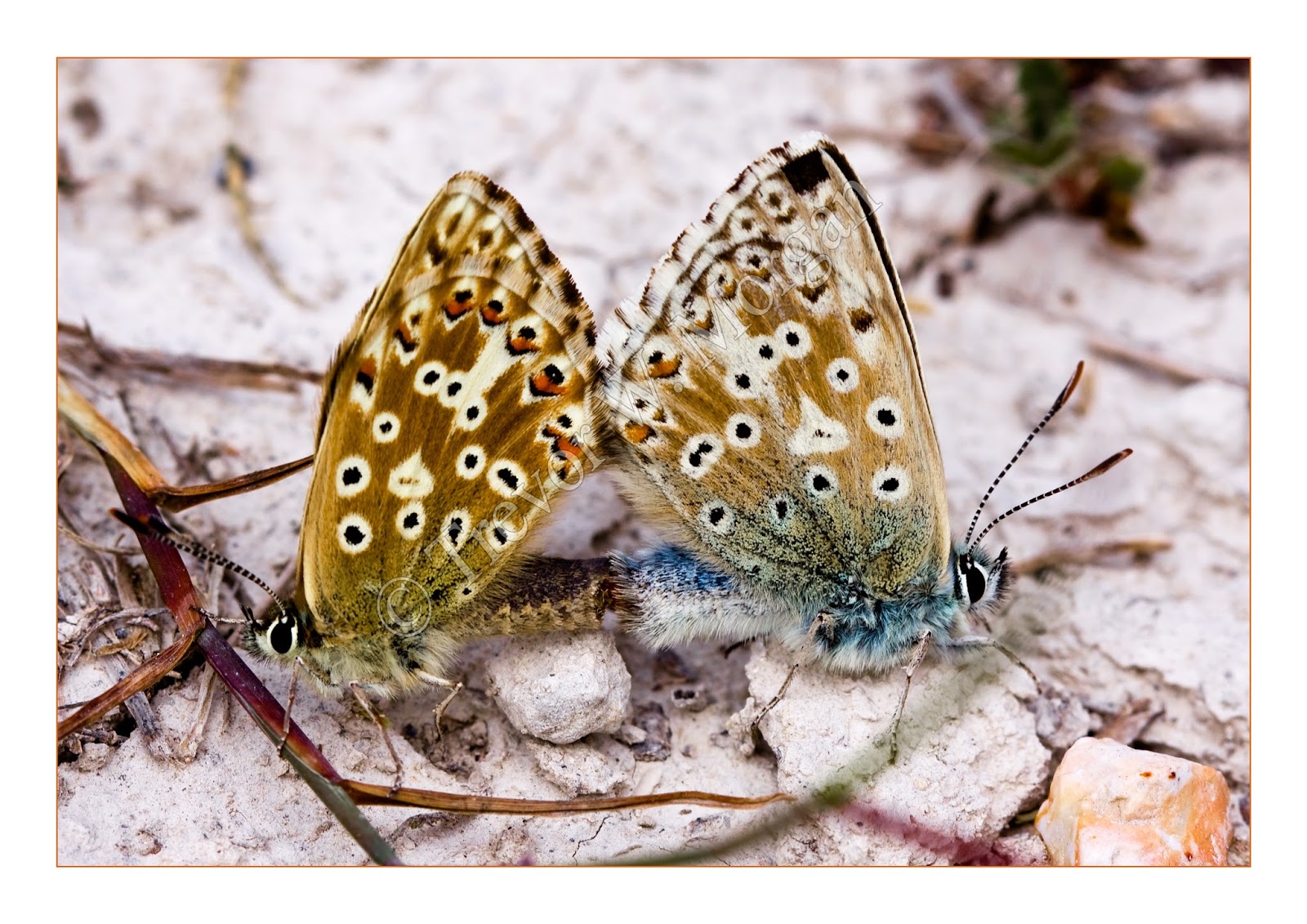
THE CHALKHILL BLUE (lysandra coridon)
As with most species, male butterflies emerge first, usually
in mid-July, and if the weather is suitable with opportunities for regular
nectaring, will live for seven weeks. Quite often though, August is the only
month one can be sure of seeing the Chalkhill Blue. It is confined to southern
England particularly over the north and south downs, the Wiltshire downs,
Chilterns, Cotswolds, Isle of Wight and Purbeck. It is very rare in south-west
England and East Anglia.
The males are very
obvious in flight or when sitting resting on plants as their powder blue colour
and large size make them quite unique.
The male has a pale powder blue upper wing surface which may
vary from a very pale silvery blue through to a greenish tinted blue according
to locality, although it always has the outer wing margin of a blackish band
with six or seven partly submerged black dots to each wing, completed by a
narrow white outer margin.
The female is dark brownish-black or soot colour, and her
rows of black dots have very slightly orange-tinted surrounds, followed by a
dingy white outer border.
The under sides of both sexes are respectively greyish and
in the female pale brownish. Both have 10 black, white-circled dots on the
forewings, and 12 on the hind wings, then a border of black dots, faintly
orange-circled in the female.
This year looks like being a good year for the Chalkhill
Blue....a couple of weeks ago I visited a site where I know there's a good breeding
colony and you can be assured of seeing them in reasonable numbers, but I was greeted by the spectacular sight of
large numbers taking nutrients from, of all things, cow pats! I counted at
least 30 individuals on one cow pat alone, and there were more on the surrounding cow pats!
And then yesterday I visited a new site (for me) less than
three miles from home where they were so numerous that it was difficult not to
step on them!
Many were busy making sure that there's a great prospect of a good emergence for next year!
Thursday, 25 August 2011
TATTERED, TORN AND FADING AWAY
Whilst out walking earlier this week I couldn't help but notice that most of the butterflies I saw were looking rather the worse for wear, as they now, after showing well all Summer and with Autumn fast approaching, start to come to the end of their life cycle.
![]() |
| Common Blue male |
![]() | |
| Common Blue female |
![]() |
| Meadow Brown male |
![]() |
| Meadow Brown female |
![]() |
| Chalkhill Blue male |
![]() |
| Gatekeeper female |
![]() |
| Gatekeeper female |
Note the slightly different (small) spot markings on these two females.
And finally my hero of the day, this badly worn Common Blue male, even in this state, still appeared able to fly perfectly well, and indeed was rigorously defending 'his patch' from anything that came remotely near!
A great example of how nature is 'hot wired' to do its thing, regardless!
Subscribe to:
Posts (Atom)