A couple of days ago I was driving past a site that, from previous years, I knew was a good place to spot some ‘early’ butterflies. It was sunny and the temperature was good, although there was quite a stiff wind blowing, so I thought that if I could find a sheltered spot I might just be lucky.
I’d only walked a few yards from the car park when I was rewarded by seeing my first butterflies, a dozen or so Green Hairstreaks ‘fighting’ over their territory around a Hawthorn bush.
Encouraged, I moved further on into the site and soon encountered more Green Hairstreaks, and in good numbers too, many more than I’d seen here in previous years. It wasn’t long before I started to see some of the other species that inhabit this site. In the end I spent over four, very enjoyable, butterfly filled hours there.
Green Hairstreak (calophrys rubi)….
Has a wingspan of 27-34mm. and both sexes are alike, except that the male has a pale oval sexual mark on the upper forewings. The upper wings are brown with a golden tinge, while the underside is an unmistakable green and carries a very fine somewhat broken white line - the 'hairstreak'. The back edge of the hindwing has some white fringing and a slightly scalloped appearance, with vestigial tail. It’s flight period is from mid April to the end of July.


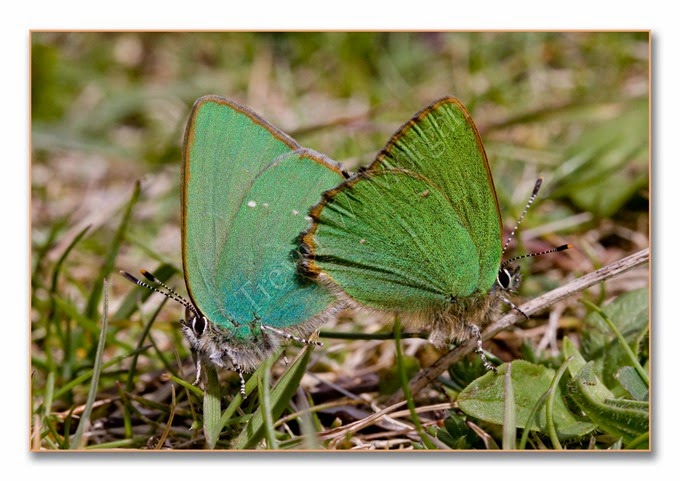 This pair wasted no time in getting down to business!
Duke of Burgundy (hamearis lucina)….
The sexes are roughly similar, the male a shade smaller with a wingspan of about 29mm. The male has a dark brown and black ground colour with 3 irregular tawny bands on the forewing, the outer containing 5 black spots near the margins. The hindwings are dark brown with 5 small oval tawny slashes and a broad dark border. Both wings have a white fringe intercrossed by black vein markings. On the underside, the forewing is dappled with black, orange, brown and white flashes with some small black centres in the outer tawny edge and, again, white fringing intersected by black vein marks.The hindwing has two white bands across and then a marginal band of orange crescents each containing black spots and finishing with the white blackcrossed fringe. The female has similar markings but they are altogether lighter and more open. The flight period is from the end of April to mid June.
This pair wasted no time in getting down to business!
Duke of Burgundy (hamearis lucina)….
The sexes are roughly similar, the male a shade smaller with a wingspan of about 29mm. The male has a dark brown and black ground colour with 3 irregular tawny bands on the forewing, the outer containing 5 black spots near the margins. The hindwings are dark brown with 5 small oval tawny slashes and a broad dark border. Both wings have a white fringe intercrossed by black vein markings. On the underside, the forewing is dappled with black, orange, brown and white flashes with some small black centres in the outer tawny edge and, again, white fringing intersected by black vein marks.The hindwing has two white bands across and then a marginal band of orange crescents each containing black spots and finishing with the white blackcrossed fringe. The female has similar markings but they are altogether lighter and more open. The flight period is from the end of April to mid June.
 Male
Male
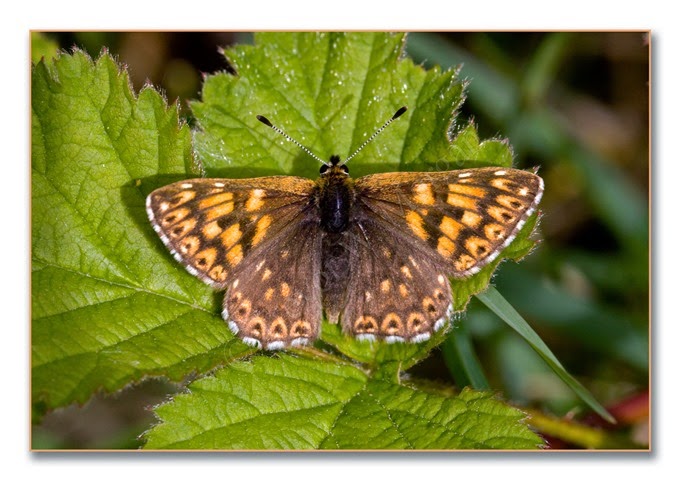 Female
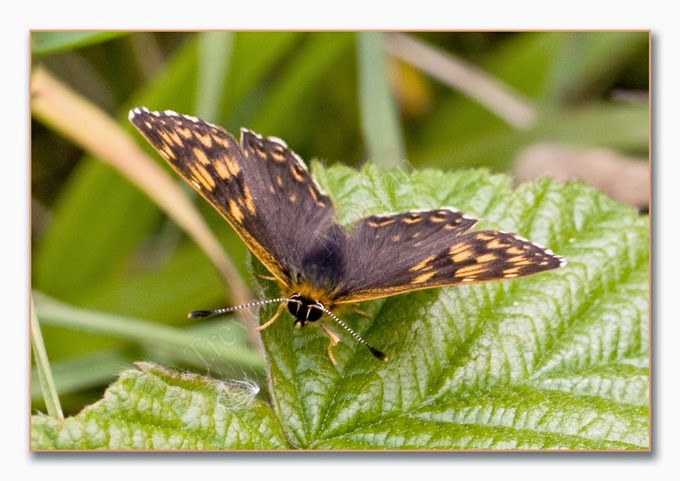
 Female underwing.
Dingy Skipper (erynnis tages)….
As its name suggests this small, moth like, butterfly has an overall dark sombre appearance, but close inspection shows an attractive, if plain, even patterning of dark and light blotches with a pale curved band across the forewings and a row of light dots around the wing edges and an outer pale fringe. The insect is about 29mm across when the wings are spread. The flight period is short..from early May to late June.
Female underwing.
Dingy Skipper (erynnis tages)….
As its name suggests this small, moth like, butterfly has an overall dark sombre appearance, but close inspection shows an attractive, if plain, even patterning of dark and light blotches with a pale curved band across the forewings and a row of light dots around the wing edges and an outer pale fringe. The insect is about 29mm across when the wings are spread. The flight period is short..from early May to late June.

 Grizzled Skipper (pyrgus malvae)….
The Grizzled Skipper is easily identified when it is settled: on the wing it is rather a blur. It is a small butterfly (27mm across the spread wings) and unmistakeably chequered black and white - the black being the dominant colour - and ornamented with numerous white square patches. The edging fringe is also black and white. Both sexes are similar but the male carries the sexual scent gland in a fold in the edge of the forewing. The underside of the wings are lighter, a grey-green colour with more obvious white patches. Flight period from late April till the end of June.
Grizzled Skipper (pyrgus malvae)….
The Grizzled Skipper is easily identified when it is settled: on the wing it is rather a blur. It is a small butterfly (27mm across the spread wings) and unmistakeably chequered black and white - the black being the dominant colour - and ornamented with numerous white square patches. The edging fringe is also black and white. Both sexes are similar but the male carries the sexual scent gland in a fold in the edge of the forewing. The underside of the wings are lighter, a grey-green colour with more obvious white patches. Flight period from late April till the end of June.
 There were not many of these around…I only managed to get this one image.
And to finish off some images of the other butterflies that I’ve taken over the last few weeks…
There were not many of these around…I only managed to get this one image.
And to finish off some images of the other butterflies that I’ve taken over the last few weeks…
 A beautiful backlit Brimstone (gonepteryx rhamni)
 The gardeners best friend…the Cabbage White or, to give it it’s proper name, the Small White (pieris rapae)
 A female Orange Tip (anthocharis cardamines)
 A Holly Blue (celastrina argiolus) getting well stuck into a Buttercup.
n.b. all the information and descriptions are courtesy of Bird Guides/British Butterflies.
A Holly Blue (celastrina argiolus) getting well stuck into a Buttercup.
n.b. all the information and descriptions are courtesy of Bird Guides/British Butterflies.
Back in February I noticed, on a wall, a clump of Moss that appeared to be ‘in flower’, curiosity got the better of me and I had to get out the macro lens and take some photographs. Later that evening while viewing the images on the computer I suddenly realised that Moss is something that can be found in many places all around us, on walls, on trees, along footpaths etc. but how often do we take the time, if we notice them at all, to have a closer look?
So, the next few times that I went ‘out and about’ I made a point of taking some more photographs…then I began to realise how diverse and beautiful these little plants are.
Now this is where the headache part comes in!…once I’d got a few photographs I needed some ID’s to go with them. Needless to say the more I looked, in books and on the internet, the more confused I became…for something so small it sure has a complicated life cycle….
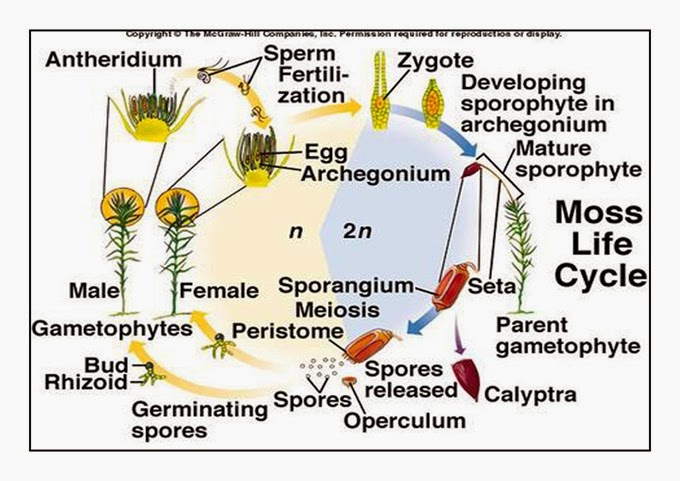 …..and some big words! I ‘borrowed’ this diagram from the internet. (© The Macraw-Hill companies, Inc.)
If you want to learn some more go to the home page of the British Bryological Society website and navigate to learning more > what is a bryophyte?
I’ve just purchased - Mosses and Liverworts of Britain and Ireland, a Field Guide - from them, hopefully, when it arrives the headaches should calm down a little??
Here’s where I’ve got to so far…
…..and some big words! I ‘borrowed’ this diagram from the internet. (© The Macraw-Hill companies, Inc.)
If you want to learn some more go to the home page of the British Bryological Society website and navigate to learning more > what is a bryophyte?
I’ve just purchased - Mosses and Liverworts of Britain and Ireland, a Field Guide - from them, hopefully, when it arrives the headaches should calm down a little??
Here’s where I’ve got to so far…
 Grey Cushion Moss (grimmia pulvinata) showing the beaked Sporangium. Sometimes referred to as Hedgehog Moss as it forms grey rounded clumps that look similar(?) to Hedgehogs. Grows on walls and rocks and is common in lowland Britain (below 1000m).
 Bristly Haircap (polytrichum piliferum) male ‘flowers’. A low growing moss, 4cm or less, common and widespread on acid soils such as dry sandy heathland.
 Juniper Haircap (polystrichum juniperinum) showing the densely packed sporophytes. Grows to about 4cm tall on free draining grassy heathland, fixed dunes etc.
 The sporophytes of at least three unknown species of Moss.
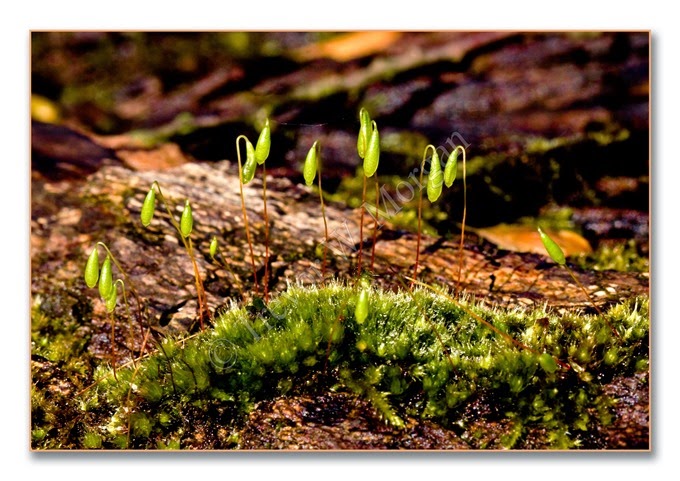
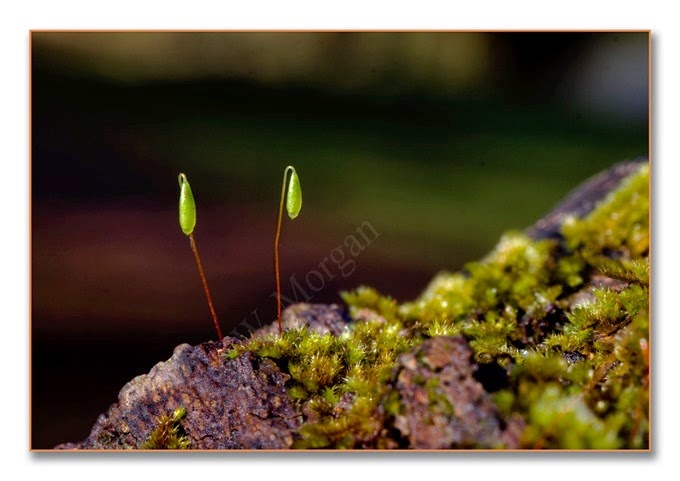 Unknown species
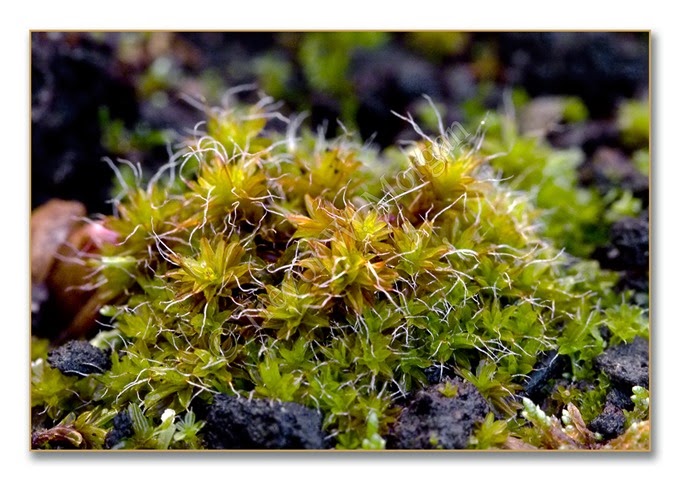 Star Moss (tortula ruralis) can grow in many types of soil but most often on calcareous soil. It has the ability to ‘dry out’,turn reddish brown and become dormant. Then, many decades later, rehydrate and become ‘active’ once again.
Not wishing to inflict any headaches on you but I hope this has inspired you to look a mosses a little closer now, I’m sure that you’ll be amazed at the beauty!
If you do want a headache…try looking at and researching Lichen, a subject that’s as equally interesting and confusing as Mosses!……Where are the pills?…I’ve got a really bad headache!!
Hopefully I've got all the ID's correct but if you've spotted something that I've got wrong please let me know.
Star Moss (tortula ruralis) can grow in many types of soil but most often on calcareous soil. It has the ability to ‘dry out’,turn reddish brown and become dormant. Then, many decades later, rehydrate and become ‘active’ once again.
Not wishing to inflict any headaches on you but I hope this has inspired you to look a mosses a little closer now, I’m sure that you’ll be amazed at the beauty!
If you do want a headache…try looking at and researching Lichen, a subject that’s as equally interesting and confusing as Mosses!……Where are the pills?…I’ve got a really bad headache!!
Hopefully I've got all the ID's correct but if you've spotted something that I've got wrong please let me know.
……a new ‘tick’.
Today I visited a new site for me, situated on the Greensand Ridge just a few miles to the south of Milton Keynes it consists of mixed woodland surrounding Gorse covered heathland. My original plan was just to explore the area to see what was about. It was pleasing to see that there was a good amount of the ‘commoner’ birds around…Blue Tits in the treetops,Coal Tits feeding on the pine cones, Skylarks singing as they rose up into the blue(ish) sky, at least five Buzzards circling and calling overhead, and sightings of Jay, Jackdaw, Carrion Crow, Magpie, Linnet, Dunnock…the signs were promising that this might be a decent site.
I then met two birders (funny how you can tell a birder from a ‘normal’ person!) and after exchanging the usual pleasantries I was asked if I’d seen the Dartford Warbler and if I hadn’t it was showing really well a couple of hundred yards further down the track. Now, I knew that a Dartford Warbler had been spotted somewhere in the area but I didn’t know that THIS was the exact spot!
I slowly walked down to the indicated area and there…singing it’s little heart out from the top of a small tree was a stunning male Dartford Warbler. I spend an enjoyable twenty or so minutes photographing it as it moved around from bush to bush.

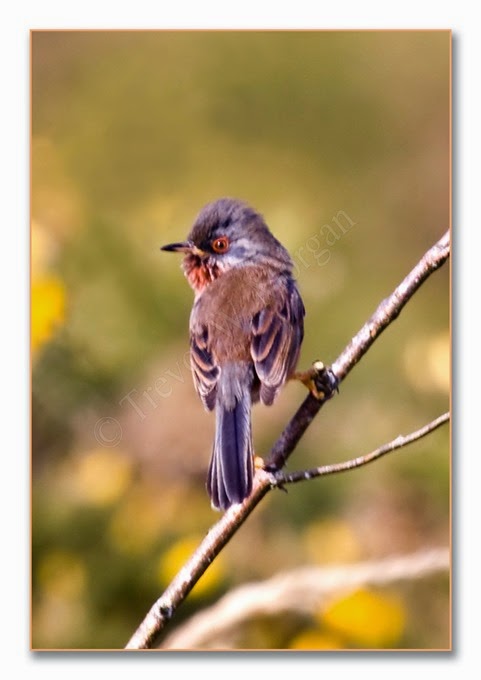

 With a brand new ‘life tick’ and some half decent photos I made my way home feeling rather happy.
Earlier this week saw me back up to Milton Keynes and another visit and walk around Caldecotte Lake (the ‘boss’ is still away!). The water was almost back down to it’s normal level although the river was still very full and fast flowing. The bird life seemed to be very sparse up at the normal gathering point on the arm behind the pub, the large flock of Wigeon that are usually there were gone, which left just a few Tufted Ducks, two drake Pochard, three Great Crested Grebe, quite a few squabbling Coot and an elusive female Goosander and that was about it.
Further round and the dam wall was covered from end to end with Black-headed Gulls with the odd Common Gull mixing in. The rest of the main lake seemed to be devoid of any birds at all, save for a couple of Mute Swans ‘upending’ close to the bank. And then I saw the reason why there were so few birds…in the distance coming from under the road bridge, side by side and, causing a large wake were two boats..a speedboat and the RIB from the yacht club! Not much hope of seeing any birds today then?
As I continued on around a large flock of Graylag Geese came flying noisily in from the meadow by the river where I’d seen them grazing earlier.
 I managed to ‘catch’ these two.
Further on around, in the quieter waters by the houses and the bandstand, I spotted a male Goosander. Taking cover behind a tree I was able to get reasonably close, and for once it hadn’t spotted me. I spent a good half an hour taking photos but with the contrast between the Goosanders dark head and white body I was having difficulty with setting the correct exposure on the camera, either getting blocked in darks or blown highlights!
Here’s two of my best efforts…
I managed to ‘catch’ these two.
Further on around, in the quieter waters by the houses and the bandstand, I spotted a male Goosander. Taking cover behind a tree I was able to get reasonably close, and for once it hadn’t spotted me. I spent a good half an hour taking photos but with the contrast between the Goosanders dark head and white body I was having difficulty with setting the correct exposure on the camera, either getting blocked in darks or blown highlights!
Here’s two of my best efforts…

 I almost got the green sheen on it’s head in this one!!
Moving on and my attention was drawn to a funny sounding cooing noise coming from the branches above me, almost like a cooing Wood Pigeon but not as clear or as loud, scanning the branches I soon located the culprit…it wasn’t a Wood Pigeon, but a Carrion Crow attempting a very good impression of one. I tried to get some video but as soon as I got the camera to focus through the branches it flew off, it’s always the way!!
Further on and I met a little old lady out walking her dog ‘have you seen the Heron’ she said
I almost got the green sheen on it’s head in this one!!
Moving on and my attention was drawn to a funny sounding cooing noise coming from the branches above me, almost like a cooing Wood Pigeon but not as clear or as loud, scanning the branches I soon located the culprit…it wasn’t a Wood Pigeon, but a Carrion Crow attempting a very good impression of one. I tried to get some video but as soon as I got the camera to focus through the branches it flew off, it’s always the way!!
Further on and I met a little old lady out walking her dog ‘have you seen the Heron’ she said ..
‘no none yet today’ I replied… ‘there’s one there’ she said pointing to a juvenile Heron on the far side of the water and then we both heard a sound…’Woodpecker’ she said…and that’s what it sounded like to me a bit weak but definitely a drumming Woodpecker. Scanning through the branches and no Woodpecker to be found, and then the drumming sound again…almost above our heads this time, an there doing it’s best to be a Woodpecker was…yep!…a Carrion Crow, the same one that was earlier being a Wood Pigeon! The little old lady went off shaking her head and saying ‘ my husband won’t believe me when I tell him about this’. I’m not sure I believed it either, I knew that Crows were intelligent birds but I didn’t know they went in for mimicry?
Not much to report from the rest of my walk around the lake, a dozen or so Cormorants loafing in the trees on the island and a small raft of gulls out in the middle of the south lake and the odd Mallard and Tufted ducks. And Keith’s ‘pet’ Robin came zooming in for some food, even before I’d got the bag of seed out of my pocket!
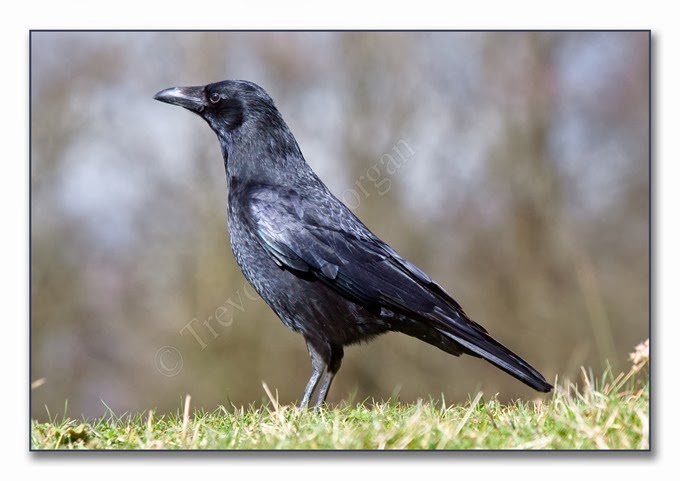
And to finish, showing well in the sunshine, a Carrion Crow…no, not ‘the’ Carrion Crow!